


IPVanish is the dependable mid-size sedan of the VPN world, and I mean that as a compliment. It is straightforward, it covers unlimited devices, it runs on a server network the company owns outright rather than rents, and it does the core job without drama or theatrics. It is not the flashiest name on my list, and it carries a piece of history worth knowing about, but for a household that wants something simple and reliable, it earns its place. My rating: 4.2 out of 5.
The quick read: IPVanish is a solid, beginner-friendly all-rounder with unlimited connections and a no-logs policy that has now been independently audited. Its weak spots are an inconsistent streaming record and a United States base, so it is a better fit for everyday privacy and torrenting than for unblocking every catalog under the sun. If those priorities match yours, it is a capable pick, and this review lays out exactly where it delivers and where it does not.
30-day money-back guarantee on annual plans.
Table of Contents
IPVanish at a glance
What it gets right:
- Unlimited simultaneous connections on a single account.
- It owns and operates its whole server network, which is rarer than it sounds and good for privacy.
- Clean, beginner-friendly apps across every platform.
- A no-logs policy independently audited in 2023.
- Torrenting is allowed, encouraged, and quick.
What I would change:
- An American home country that sits within the 14 Eyes group.
- A 2016 logging incident under earlier ownership that left a mark on its reputation.
- Streaming support is hit-or-miss next to the specialists, with Netflix mostly limited to US and UK libraries.
- Long-distance speed is good rather than class-leading.
The history worth knowing
I am not going to skip past this, because trust is the entire point of a VPN. Back in 2016, under previous ownership, IPVanish handed user activity records to United States authorities in a criminal case, despite advertising a no-logs policy at the time. That is a serious black mark, the same broken-promise failure that should make any careful buyer sit up, and it is the first thing you deserve to weigh before anything else in this review.
What has happened since matters too, and it is a genuinely different picture. The service changed hands twice in the years after, ending up under Ziff Davis, the American media group that also owns StrongVPN, and in 2023 it brought in the Leviathan Security Group to run an independent audit that confirmed its current no-logs practices. So you are weighing a documented past failure against a documented present that has been checked by an outside firm, which is a better basis for a decision than either blind trust or permanent condemnation. My own read is that a company under new ownership, with a fresh audit on the record, has earned the right to be judged on what it is now, with the history kept firmly in view rather than either forgotten or treated as the whole story.
The caveat sits alongside that. The 2016 incident happened in the United States, and IPVanish is still based there, so the jurisdiction that made the original disclosure possible has not changed even though the ownership and the policies have. Whether the audit and the new management outweigh that is a personal call, and I will lay out the privacy picture in full further down so you can make it with the facts rather than the headline.
Who IPVanish is for
IPVanish fits a clear kind of buyer. The natural owner is someone who wants a simple, dependable VPN to cover a whole household for everyday privacy and torrenting, values an easy app and a network the company controls itself, and is comfortable with a United States base once they have read the history above. For that person the unlimited connections and the owned network are real, practical advantages, and the price keeps it easy to justify.
Two groups should steer clear. The first is the dedicated streamer who wants to hop between regional catalogs at will, because IPVanish’s unblocking is patchier than the streaming specialists and Netflix access is mostly confined to the US and UK. The second is the privacy purist who insists on a spotless record and an offshore jurisdiction, for whom the 2016 history and the US base will weigh too heavily no matter the subsequent audit. For straightforward, whole-home coverage, though, IPVanish does the job without fuss.
To put a name to it, the buyer I most often point here is the household downloader: someone who torrents a fair bit, wants every device in the house covered without counting slots, cares more about a steady, private connection than about unblocking ten Netflix regions, and is comfortable enough with the 2016 story once they have read that an outside auditor has since checked the books. For that person the owned network, the unlimited connections, and the torrenting focus line up almost perfectly, and the inconsistent streaming barely registers because it was never the point. It is a deliberate pick for a clear use case rather than a default everyone reaches for, and knowing whether you are that buyer makes the decision quick.
Unlimited devices and a network it owns
Two things genuinely set IPVanish apart from the crowd, and the first is the unlimited simultaneous connections. One subscription protects every phone, laptop, tablet, and television you own at the same time, with no cap to ration and nobody forced offline so someone else can connect. For a family, or for anyone with a drawer of half-used gadgets, that single feature makes IPVanish cheaper per device than a capped rival charging the same money, the same household-friendly trick that makes Surfshark such good value.
The second is quieter but, for a privacy tool, arguably more important: IPVanish owns and runs its own server network rather than renting capacity from third-party data centers, the way most providers do. That matters because rented hardware is hardware someone else can physically reach, and outside access to servers has caused real incidents for other VPNs over the years. By controlling its own machines end to end, IPVanish closes off that whole category of risk, and it is the kind of structural advantage that does not show up in a flashy feature list but genuinely strengthens the privacy case. Between the unlimited devices and the owned network, IPVanish offers two things that together punch above its modest profile.
It is worth dwelling on why owning the network is more than a talking point. When a VPN rents servers, it is trusting a chain of data-center staff and contractors it does not employ, and a single compromised rented machine has been enough to embarrass providers far bigger than IPVanish. Running your own hardware does not make you invulnerable, but it shrinks the number of hands that can touch the servers your traffic passes through, and it lets the company patch, configure, and decommission them on its own terms rather than a landlord’s. For a service whose whole pitch is dependability, that end-to-end control is of a piece with the rest of the character: fewer moving parts, fewer outside dependencies, fewer surprises. It is the kind of thing that never sells a subscription on its own but underwrites everything else.
Speed and security
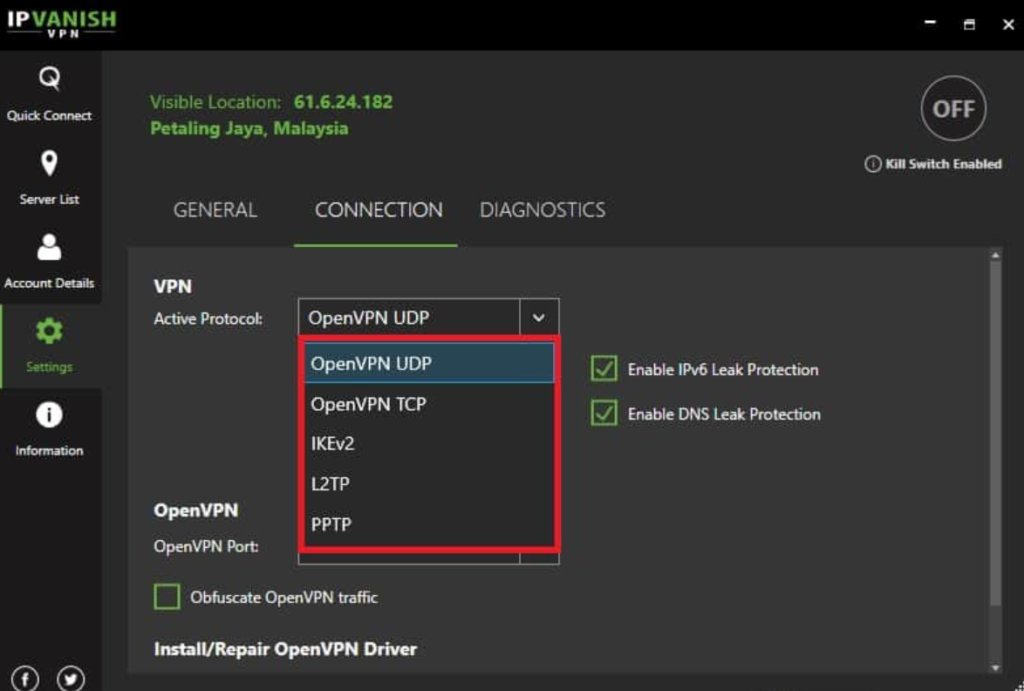
IPVanish runs WireGuard, and the speeds are good, strongest across America where it packs in the most servers. Testing saw a 250 Mbps line stay in the mid-230s on the better servers and slip into the 200-to-225 range on more distant ones, which is solid throughput with the usual penalty for reaching across the map. Streaming in high definition, video calls, and downloads all feel normal on a nearby server, and while it is not the absolute fastest on the longest intercontinental routes, the difference is one most people will never notice.
On security the fundamentals are all correct. The encryption is AES-256, the kill switch fires reliably and severs your traffic the instant the tunnel breaks so nothing escapes during the lapse, and the major leak tests come back clean on DNS and WebRTC, which squares with what I find testing it myself. Split tunneling lets you push chosen apps around the VPN, and the apps even show a live throughput graph for the people who like to watch the numbers tick. Nothing here is exotic, but every fundamental is done correctly, which for a service selling dependability is exactly the right priority.
Streaming and torrenting
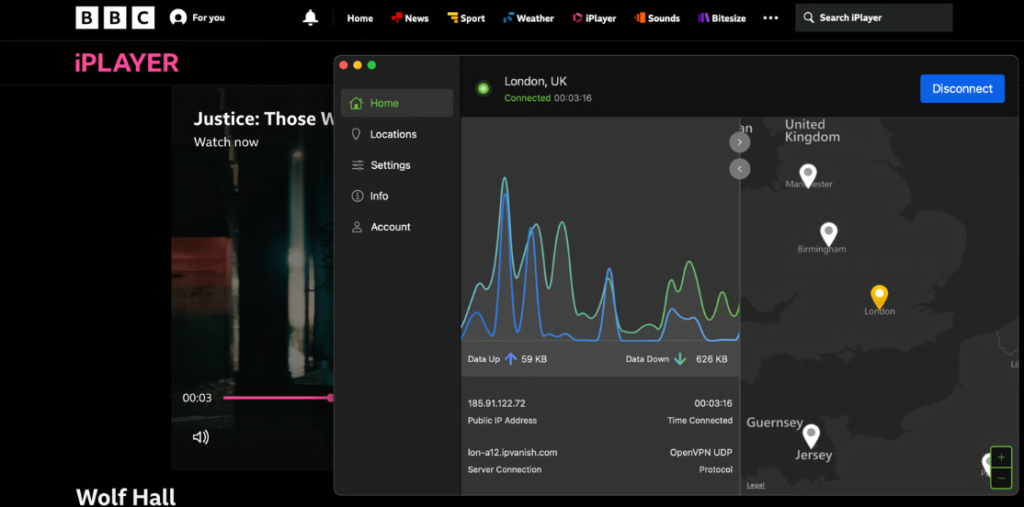
Streaming is the soft spot, and I will not oversell it. IPVanish unblocks US Netflix and some other services much of the time, but it is less consistent than the dedicated streaming providers, and independent testing found its Netflix access largely confined to the US and UK libraries rather than the wider spread you get elsewhere. I have had servers that worked one week and got blocked the next, which is the frustrating pattern with a provider that does not maintain labeled streaming servers. If unblocking a broad range of catalogs is your main goal, CyberGhost or NordVPN will frustrate you far less, and I would steer a streaming-first buyer their way.
It is worth being precise about what that means in practice, because “inconsistent” can sound worse than it is. If your watching is mostly US and UK Netflix plus the big services on their home servers, IPVanish will probably serve you fine day to day; the trouble starts when you want a less common regional library or a service that polices VPNs hard, where you may cycle through several servers and still come up short. The absence of labeled, service-specific streaming servers is the root of it, since you are picking a location and hoping rather than connecting to a server maintained for that exact catalog. For a household whose streaming needs are modest and mostly domestic, the gap is easy to live with; for the dedicated catalog-hopper, it is the single best reason to buy elsewhere.
Torrenting is the brighter side, and a genuine strength. P2P is welcome on every server rather than fenced onto a handful, and if the tunnel ever drops mid-download the kill switch stops your real IP from reaching the swarm at all, while the unlimited connections let you protect every machine in the chain without logging anything out. The owned network adds a layer of reassurance to the activity, and the audited no-logs policy is exactly the backing downloading calls for. It makes a comfortable home on my best VPNs for torrenting list, and for the household that downloads as much as it streams, the torrenting strength may well outweigh the streaming gap.
The split tunneling is the enabler that ties the torrenting together. You can route the download client through the VPN while leaving a banking app or a local service on your ordinary connection, so you never have to choose between protection and a site that dislikes VPNs. Combine that with the unlimited connections and a spare machine can grind through downloads overnight while the rest of your devices stay protected in parallel, which is exactly the arrangement a serious-but-casual downloader tends to want. None of it is complicated to arrange, and once set it simply works, which is the recurring theme with IPVanish: capable where it counts, and undemanding about it.
IPVanish for travel

On the road, IPVanish leans on the things it is good at. The unlimited connections are the first: a travel kit is rarely one device, and being able to cover a laptop, a phone, and a tablet under one login without thinking about it is a relief when you are hopping between hotel networks and airport WiFi. The owned network is the second, because a connection that holds steady matters more away from home than anywhere else, and IPVanish has been dependable for me across a string of patchy connections rather than the flaky drop-outs that plague cheaper services.
The limits travel surfaces are the streaming and the censorship. Working from an apartment in Cape Town for a stretch, the encryption and the everyday protection were faultless, but the streaming was the same mixed bag it is everywhere: US and UK catalogs came up, others were hit or miss. And IPVanish is not the tool I would carry into a heavily censored country, where it lacks the obfuscation track record of the providers built for that fight. For the ordinary run of travel, the normal countries and the standard hotel and café networks, it is a steady companion; for unblocking the world’s catalogs or beating a national firewall, it is not the specialist you want.
Privacy, the US base, and the audit
The privacy picture today is better than the 2016 headline suggests, with one standing caveat. On the positive side, IPVanish keeps no activity logs, and that claim is no longer a matter of trust alone: the 2023 Leviathan Security Group audit examined the practices and confirmed them, which is the verification the original policy lacked. The owned-network advantage reinforces it, since controlling the hardware removes a route by which data could be exposed without the company’s knowledge. For a provider rebuilding credibility, an outside audit plus self-run servers is a sound combination.
It helps to be clear about what an audit like the 2023 one does and does not settle. An independent firm examining the logging setup confirms that, at the time it looked, the systems matched the no-logs claim, which turns a bare promise into a checked one. It does not freeze that state forever, and it cannot prove a negative for all time, so it is evidence rather than a guarantee. But evidence is exactly what the 2016 version lacked, and the combination of a named auditor’s findings, open accountability under new ownership, and hardware the company controls end to end is about as much reassurance as a US-based provider can realistically offer. Whether that clears your personal bar is the decision, and it is a more informed one than the old headline alone would let you make.
The caveat is jurisdiction, and it is the one thing the rebuild cannot touch. The company sits in the United States, part of the 14 Eyes group, and the very country whose legal process forced the 2016 disclosure to begin with. The strongest answer is the one that holds for any audited no-logs provider: a service that truly stores nothing has nothing to surrender wherever it is registered, and the audit is there precisely to stand behind that. But if an offshore home with no surveillance-alliance ties is non-negotiable for you, ProtonVPN and its Swiss base will suit you better, and it sits above IPVanish on my best VPNs for privacy list for that reason. IPVanish is a reasonable everyday privacy choice; it is not the one for a maximal threat model.
The apps, ease of use, and support
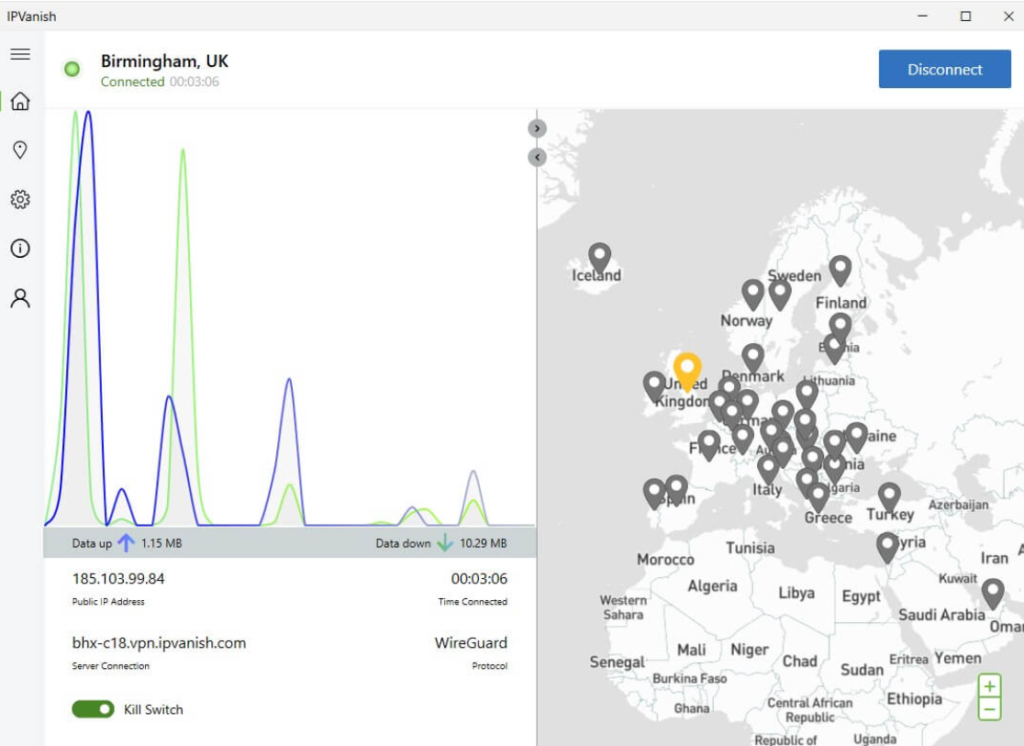
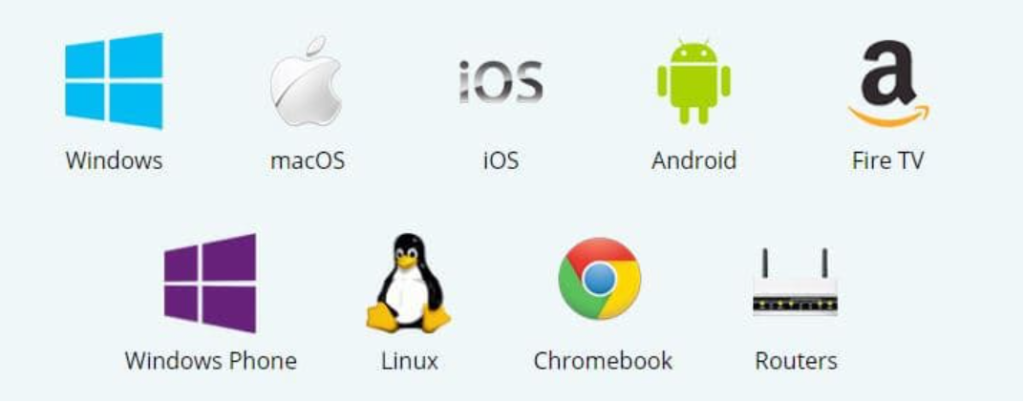
The apps for Windows, macOS, iOS, Android, and Fire TV are clean and easy to navigate, which is why IPVanish has long been pitched at newcomers. There is a touch more detail on screen than the absolute simplest apps, the live throughput graph being the obvious example, but nothing that gets in the way of someone who just wants to press connect. That graph is a small tell of who IPVanish is really for: it is the sort of thing a tinkerer enjoys glancing at and a casual user ignores entirely, and the app accommodates both without forcing the second group to engage with it. The reconnection handling is another touch, with the app letting you set how hard it tries to restore a dropped connection, which matters on the patchy networks where it earns its keep. It makes a fine first VPN, easy to set up for a less technical member of the household and then leave alone, and it sits among my solid picks for newcomers. The Fire TV app in particular is handy for protecting the living-room screen without flashing anything onto a router.
Help comes through round-the-clock live chat, and my own experiences with it have been quick and genuinely useful, landing me with a person who could solve the problem rather than a wall of canned lines. A thorough knowledge base sits behind it for anyone who would rather work things out alone. For a service pitched partly at first-timers, a real human reachable at any hour is the reassurance that audience most needs, and it is one of the reasons IPVanish works for a household. If you are new to all this, my VPN setup guide walks each platform through the basics.
Setting up IPVanish
Getting going is quick. Create an account, grab the app for your device, sign in, and connect, and the defaults have you protected from the first tap. To tune it, flip the kill switch on, set the protocol to WireGuard for the quickest connection, and configure split tunneling if you torrent. Since the connections are unlimited, there is no point leaving anything uncovered, so install it on every device you own, and for a smart TV reach for the Fire TV app or a router. The whole process is about as painless as VPN setup gets, which is rather the point of a service built on being dependable rather than clever.
IPVanish pricing and plans
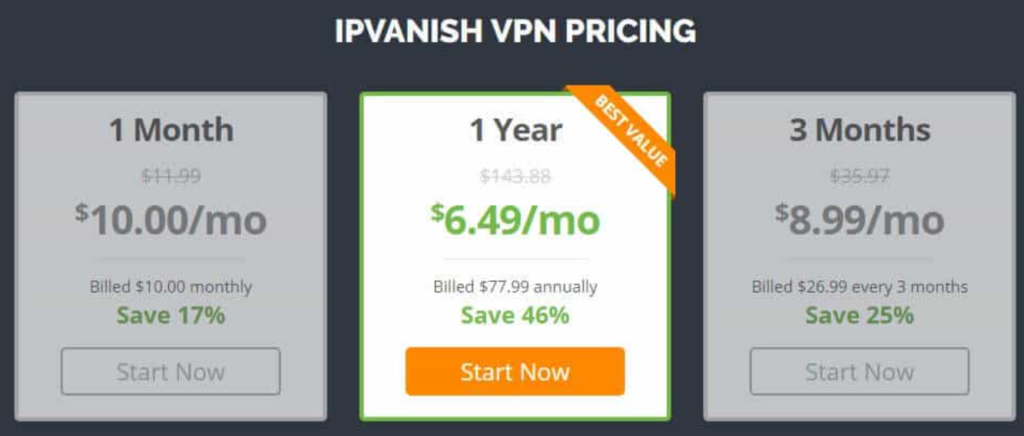
IPVanish is mid-priced and fair. The two-year plan works out to around $2.49 a month, the one-year to roughly $3.33, and the monthly plan carries the usual short-term markup. There is a Complete tier that folds in cloud storage and a password manager for anyone who wants the wider bundle, but the core VPN stands on its own. The 30-day money-back guarantee applies to the annual plans, so take a yearly term if you want the refund safety net, with card, PayPal, and crypto all accepted at checkout. For unlimited devices and an owned, audited network, the price is competitive, and it is a fair-value pick rather than a rock-bottom one.
| Key facts | IPVanish |
|---|---|
| Price | From about $2.49/mo (2-year plan) |
| Money-back guarantee | 30 days (annual plans) |
| Simultaneous devices | Unlimited |
| Servers | 2,400+ servers, all self-owned |
| Jurisdiction | United States (Ziff Davis) |
| Protocols | WireGuard, IKEv2, OpenVPN |
| Encryption | AES-256 |
| Logging | No-logs, audited by Leviathan (2023) |
| Streaming | US and UK Netflix and others, but inconsistent |
30-day money-back guarantee on annual plans.
What is new for 2026
IPVanish has spent recent years doing the work that turns a provider with a black mark into a credible recommendation again. The headline is the 2023 Leviathan audit, which put an outside firm’s name behind the no-logs claim that the 2016 version had only asserted, and that single step does more for the buying case than any feature could. WireGuard has bedded in as the default to lift the everyday speeds, the apps have had steady usability work that makes them genuinely easy rather than merely functional, and the move to unlimited connections has reshaped the value story for households. The self-owned network has stayed central to the pitch throughout. None of it rewrites what IPVanish fundamentally is, a plain, dependable, multi-device VPN, but it is the picture of a service being actively maintained and rehabilitated rather than left to trade on an old name.
How IPVanish compares
Against the value champion, the comparison is close and instructive. Surfshark also covers unlimited devices at a low price, but it unblocks far more streaming and carries no comparable scandal, so for a streaming-led household it is the easier call. Where IPVanish answers back is the owned network and the torrenting focus, which appeal to a more privacy-and-download-minded buyer. Against the all-rounders, NordVPN is faster, streams better, and works in China, and it is the pick if you want one VPN to do everything. And if a clean record and an offshore base lead your list, ProtonVPN is the name to weigh. IPVanish’s lane is specific: simple, unlimited, owned, and audited, for the buyer who values those four things over the last word in streaming or jurisdiction. The closest call is really IPVanish against StrongVPN, since they share the Ziff Davis parent and the dependable-rather-than-dazzling character; IPVanish edges it on the unlimited connections and the broader network, while StrongVPN counters with its Smart DNS, so the tie-breaker comes down to whether you weigh device count or living-room streaming more heavily.
Reliability and the trade-offs
The downsides are the ones raised as we went, collected here for an easy side-by-side. The 2016 history leads the list, and for some people it is a permanent dealbreaker, which is a defensible stance even given the later audit and the changes of ownership. The American jurisdiction sharpens that worry for anyone bracing against legal pressure, though a truly empty log has nothing to give up either way. And the patchy streaming is the practical one, the limit you will run into if regional catalogs are a big part of why you want a VPN at all.
Weighed against those is a genuinely dependable service: unlimited devices, a network the company owns and has audited, strong torrenting, clean leak results, and a friendly app with support to match. None of the limits ruin IPVanish for the everyday, privacy-and-torrenting household it targets, or it would not sit where it does among my picks. But a review that hid the history and the streaming gap behind the strengths would be no use to you, and the 30-day guarantee on the annual plans means you can confirm every one of these judgments against your own use before committing.
IPVanish FAQ
Is IPVanish safe to use?
Today, yes. It uses AES-256 encryption, includes a reliable kill switch, leaks nothing in testing, and its no-logs policy was independently audited by Leviathan in 2023. The context is a 2016 logging incident under earlier ownership, before the audit and the changes of hands that followed.
How many devices does IPVanish support?
Unlimited simultaneous connections, so one account protects every device you own at once. That makes it strong value for families and multi-device households, with no slot to ration across phones, laptops, tablets, and the television.
Does IPVanish work with Netflix?
Sometimes, and mostly for the US and UK libraries. It unblocks those much of the time but is less consistent than streaming-focused providers, and access to other regional catalogs is patchy. If reliable streaming across many regions is your priority, CyberGhost or NordVPN are safer bets.
Is IPVanish good for torrenting?
Yes, it is one of its strengths. P2P is allowed and encouraged on every server, the kill switch shields your real IP, the self-owned hardware adds reassurance, and unlimited connections let you cover every device. It is one of the better mid-priced torrenting VPNs.
Why does it matter that IPVanish owns its servers?
Most VPNs rent server space from third-party data centers, which means outside parties have physical access to the hardware. By owning and running its own network, IPVanish removes that access and the risk that comes with it, which is a genuine, if understated, privacy advantage.
Can I trust IPVanish after the 2016 incident?
That is a personal call. In 2016, under previous ownership, it handed over user records while claiming to keep none. It has since changed hands, settled under Ziff Davis, and passed an independent 2023 audit backing its current no-logs practices. The failure is real, and so is the checked improvement that followed.
Does IPVanish keep logs?
It says no, and that claim was independently audited by Leviathan in 2023. The caveat worth knowing is the US jurisdiction, though a policy that genuinely retains nothing leaves nothing to hand over no matter where the company is based.
Is IPVanish good value?
It is fair value rather than the cheapest. Around $2.49 monthly on the two-year term, with unlimited devices, a self-owned network, and an audited policy, buys a dependable package, though a streaming-led buyer can get broader unblocking for similar money from Surfshark.
Does IPVanish slow down your connection?
Not by much close to home, where testing held a 250 Mbps line in the mid-230s, and the strongest results come on American servers, where it runs the most hardware. Routes that reach further lose more, the usual pattern, but for streaming, calls, and downloads on a sensible server choice it stays plenty quick.
Is IPVanish based in the United States a problem?
It is a fair worry, since America belongs to the 14 Eyes group and was where the 2016 disclosure took place. The counter is that a genuinely empty no-logs policy, now audited, holds nothing to surrender wherever the company sits. If an offshore base is a firm requirement, ProtonVPN is the better fit.
Does IPVanish offer a free trial?
Short trials show up on mobile through the app stores, and the annual plans come with a 30-day money-back guarantee that amounts to a risk-free month: pay, put it through real use, and request your money back before the 30 days are up if it disappoints. The monthly plan is not covered, so pick an annual term if you want that safety net.
Verdict: who should buy IPVanish
Buy IPVanish if you want a simple, dependable VPN with unlimited devices for everyday privacy and torrenting, and you are comfortable with a United States base and the company’s history once you have read it. It is a natural fit for families and newcomers who value an easy app, responsive support, and a network the company controls itself, and the torrenting in particular is a real strength rather than an afterthought.
Two kinds of buyer are better off elsewhere: heavy streamers, who will be happier with CyberGhost or NordVPN and their broader unblocking, and privacy purists set on a spotless record and an offshore jurisdiction, where ProtonVPN is the fit. For straightforward, whole-home coverage from a provider that has owned its past and had its present checked, though, IPVanish does the job, and you can place it against the rest on my best VPNs of 2026.
If a no-fuss VPN for the whole household is the goal, this is a sensible buy. Take the annual plan so the 30-day guarantee applies, put it on every device you own without a second thought about the count, and treat the self-owned network and the independent audit as the reassurance they are genuinely meant to be. A VPN can do worse than to be dependable and a little dull, and that is precisely what IPVanish has settled into being. After a public failure, a couple of changes of ownership, and an audit to back the rebuild, settling into reliable and unremarkable is not a small achievement; it is the whole comeback in a phrase, and for the household it suits, reliable and unremarkable is exactly what you want humming away in the background while you get on with your life and forget it is even there, which is the highest praise a tool like this can really earn.
30-day money-back guarantee on annual plans.
Leave a Reply
You must be logged in to post a comment.