

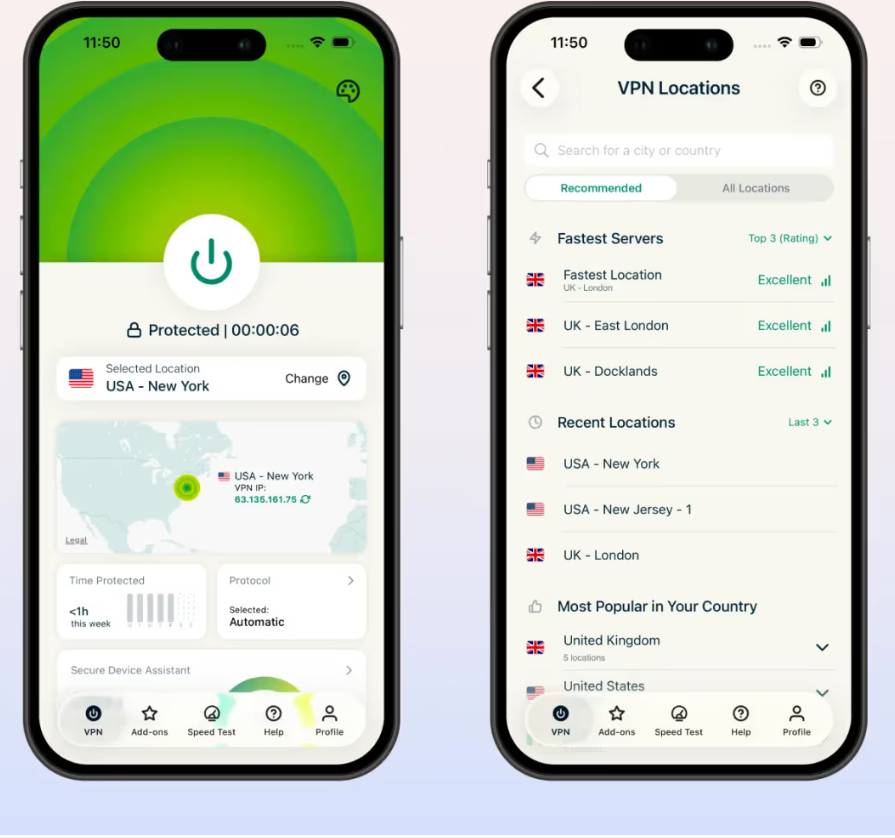
ExpressVPN is the one I hand to people who never want to think about their VPN again. It is quick, the apps are the least irritating in the business, and it has held a connection for me in hotels and countries where flakier services simply shrugged and quit. That polish has always carried a premium, and ExpressVPN has never been shy about charging for it. So here is my verdict for 2026: if a smooth, no-fuss experience matters to you more than squeezing out the last possible dollar, this is worth the money, and the new cheap long-term plans have defused the oldest complaint against it. My rating: 4.6 out of 5.
Here is the gist before the detail. ExpressVPN is the premium pick for people who value a flawless, frictionless experience over saving a few pounds, with the fastest-feeling protocol in the category, a security record that has survived a real-world server seizure, and apps anyone can use on the first try. Two things weigh against it, the price even after the recent cuts and the company that owns it, and I will deal with both squarely. If price is the single thing that decides it for you, I will point you somewhere cheaper before the end.
30-day money-back guarantee, cancel anytime.
Table of Contents
ExpressVPN at a glance
What it gets right:
- Lightway, the proprietary protocol rebuilt in Rust and hardened against future quantum threats, which makes the connection feel close to invisible.
- TrustedServer technology, running the whole fleet from RAM so nothing is ever written to a disk.
- A no-logs policy proven the hard way, when a seized Turkish server yielded nothing, and confirmed by repeated outside audits.
- The most polished, fuss-free apps in the category, plus 24/7 support that helps.
- Reliable streaming and a real record of connecting inside China, where most VPNs simply fail.
What I would change:
- It is still a premium price, even with the new long-term discounts narrowing the gap.
- Kape Technologies owns it, a fact the privacy-minded will want to think over.
- The device limit, around eight simultaneous connections, trails the unlimited crowd.
- The cheapest rivals undercut it heavily if raw value is your priority.
Speed and the Lightway protocol
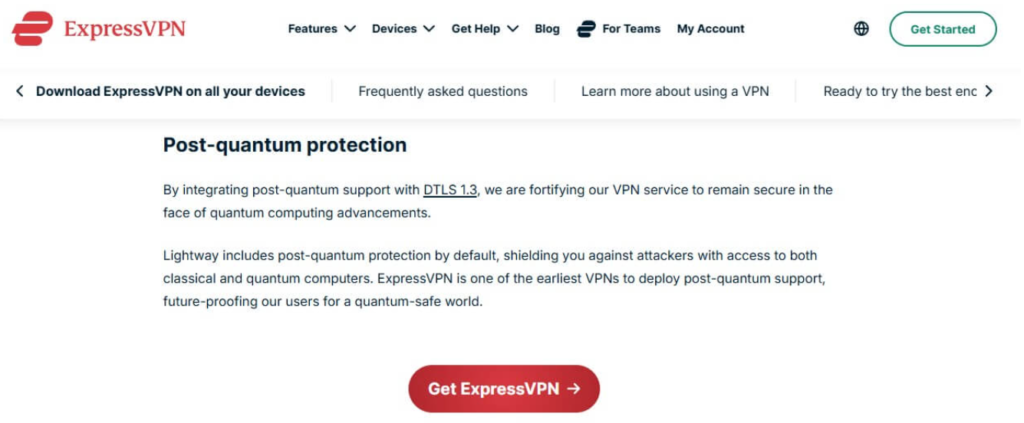
Lightway is ExpressVPN’s own protocol, and it is the reason the service feels nimble rather than merely fast on a chart. It establishes a connection in about a second, and more to the point, it survives the small indignities of travel: I have watched it hold the tunnel intact while my phone jumped from a tired hotel network to a cellular signal down in the lobby, with none of the dropouts that send lesser apps reconnecting three times and losing your download. The recent rewrite of Lightway in Rust, a language built for memory safety, has made it both leaner and easier to audit, and ExpressVPN has folded in post-quantum protection so the encryption holds up against the computers that do not exist yet.
The raw numbers hold up to the feel. In testing, a 250 Mbps line stayed in the 240s on nearby servers and held the 190s to 220s on more distant ones, which is excellent given that even fast VPNs commonly shed around 20 percent locally and more than half over the longest hops. Where ExpressVPN still pulls ahead of the field is distance: routing from Southeast Asia back to London or New York is the real test, the kind of long-haul connection where most providers sag, and it holds its composure better than almost anything I have used. That long-distance steadiness is the single hardest thing for a VPN to get right, because physics is working against it the whole way, and it is where the cheaper providers most often come apart. ExpressVPN does not defy the distance so much as manage it gracefully, shedding a predictable slice rather than collapsing, which is exactly what you want when the server you need is half a world from where you are sitting. If your daily reality involves connecting across oceans, that consistency is the single best argument for paying what it asks.
Gaming benefits from the same quickness. The ping on a close server barely moves, enough that online play feels normal, and while no VPN will beat a direct connection on latency, ExpressVPN comes closer than most and can even help by routing around an internet provider that throttles game traffic. It is not marketed as a gaming tool and does not need to be; like everything else here, it simply gets out of the way. Meshing low latency with the stability to survive a network hiccup mid-match is more than most VPNs manage, and it is one more place where the polish shows up as an absence of problems rather than a headline feature. That, in a sentence, is the whole pitch: not a longer spec sheet than the rivals, but fewer small things going wrong across the years you’d use it, day in and day out, on each and every single device that you happen to own.
What you are paying for
Since the price is the whole debate with ExpressVPN, it helps to be specific about what the premium buys, because “it is more polished” is too vague to spend money on. The first thing is reliability under stress: the connection that does not drop when you move between networks, the server that is up when you need it, the kill switch that fires on time. Cheaper VPNs get this right most of the time; ExpressVPN gets it right nearly all of the time, and that last sliver of consistency is what you are paying for. It does not show up in a feature comparison, only in the absence of small daily annoyances.
The second is the things that are genuinely hard to build: a protocol fast and stable enough to feel invisible, a server design proven under seizure, and a real working record inside China. Plenty of providers claim the last one; few deliver it. The third is the part nobody markets, which is that the apps are simply nicer to use, and over a two-year subscription that you touch every day, “nicer to use” compounds into real value. None of it justifies the price for a buyer on a tight budget, and I would never pretend it does. But for the buyer whose time and patience are worth more than the difference, the premium is buying something concrete rather than a logo.
Who ExpressVPN is for
Buy ExpressVPN if you want the path of least resistance. Frequent travelers who change networks all day, streamers who are tired of fiddling with servers, and anyone who would rather pay a little more than spend a single evening troubleshooting are the natural owners. It is the VPN I recommend to relatives precisely because I know I will not get a follow-up phone call, and that reliability is worth real money to the person whose time is the scarce resource rather than their budget.
Look elsewhere if value leads your list. NordVPN offers comparable speed and a deeper feature set for less, and Surfshark undercuts nearly everyone while handing you unlimited devices. The household trying to cover a dozen gadgets will also feel the eight-connection limit sooner than they would on an unlimited rival. ExpressVPN is not trying to win the value argument; it is trying to be the one that never makes you think, and for the buyer who prizes that above all, it succeeds.
To put a face on it, the person I hand ExpressVPN to most often is the busy non-technical professional who travels for work, expects things to function, and treats an hour of troubleshooting as a worse outcome than a slightly higher bill. They want their home streaming on the hotel TV, their email and bank working from another continent, and zero homework, and they would genuinely rather pay more than learn what a protocol is. For that person the calculus is simple: the premium costs less than the value of never having to deal with it, and ExpressVPN is built end to end around being the VPN such a buyer forgets they are even running.
Security, encryption, and TrustedServer
Under the hood, ExpressVPN uses the encryption you want and never makes you think about it. On its OpenVPN and IKEv2 connections it runs AES-256, the standard the serious industry relies on, while Lightway leans on ChaCha20 or AES depending on your device, and the whole thing ships with Perfect Forward Secrecy, which means that even if someone cracked a single session’s key they could not use it to unpick your past or future sessions. The defaults are correct, so most people never need to touch a setting.
Two features matter more than the acronyms. The first is Network Lock, ExpressVPN’s kill switch, which cuts your traffic the instant the connection drops so your real address never leaks during the gap, and in my testing it fires when it should rather than a beat too late. The second is TrustedServer, the name for running the entire fleet on RAM instead of hard drives. Nothing is written to disk, and every reboot wipes each server back to a clean slate, which means there is simply no stored history for anyone to seize or subpoena after the fact. It is a genuine privacy improvement rather than a marketing flourish, and it has become the bar the other premium providers now have to clear.
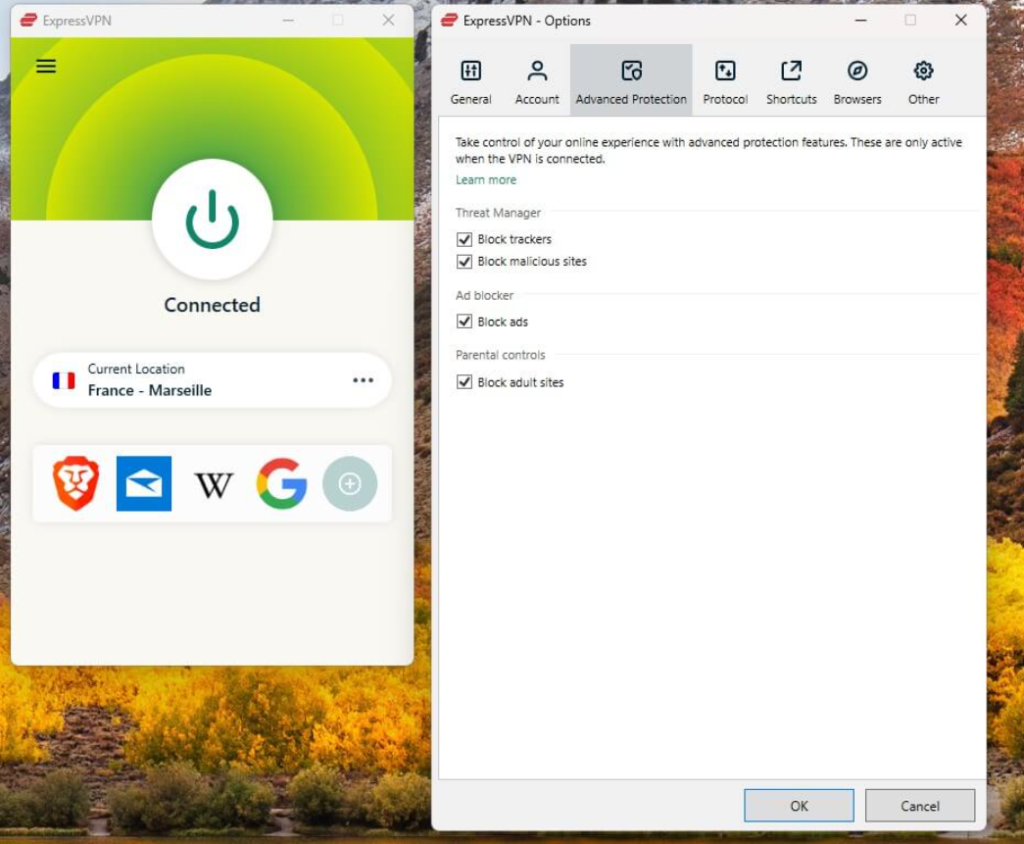
The leak protection rounds it out. Independent testing finds no IP, DNS, IPv6, or WebRTC leaks, in line with what I find myself, and a Threat Manager blocks trackers and malicious domains alongside an ad blocker. None of this asks anything of you; it is all on by default or a single toggle away, which is exactly the point of a service that sells itself on never making you work.
It is worth a moment longer on TrustedServer, because it is the piece that turns a privacy promise into something nearer a guarantee. A conventional server writes data to a hard drive, which means a snapshot of activity can survive a power-down and be recovered, seized, or subpoenaed afterward. Running entirely from RAM removes that possibility at the hardware level: cut the power and the slate is wiped, every reboot bringing the machine up from a clean, freshly verified image. The 2017 Turkish seizure is the proof of concept the whole industry now cites, since the investigators left with a server that genuinely held nothing. ExpressVPN built this before it was fashionable, and the rest of the premium tier has spent the years since catching up, which is about the strongest endorsement a design can earn.
Privacy, jurisdiction, and the Kape question
ExpressVPN is based in the British Virgin Islands, which has no mandatory data-retention laws and no friendly neighbor to pass your records to. Its no-logs policy says it keeps nothing that could tie activity back to you, and unlike most such claims, this one has been tested in the worst possible way. In 2017, Turkish investigators seized one of its servers during an investigation and reportedly walked away with nothing usable, because there was nothing to find, the TrustedServer design working exactly as intended. That real-world seizure is stronger evidence than any planned audit, and the audits exist too: ExpressVPN has been examined repeatedly by outside firms, with KPMG’s 2025 assessment of the TrustedServer controls reported finding no exception noted, and Cure53 reviewing its apps and tools across several engagements.
Now the part the glossy review sites tend to hurry past. Kape Technologies has owned ExpressVPN since 2021, and Kape’s corporate past is not spotless; some privacy advocates still eye it warily because of where it came from, and I am not going to wave that off. What I will say is that the outside audits have kept coming since the acquisition, the seizure proof sits on both sides of it, the British Virgin Islands structure is unchanged, and nothing I have seen points to the logging the worry implies. If absolute corporate purity is your bar, ProtonVPN will sit easier, and its Swiss, independently owned setup puts it above ExpressVPN on my best VPNs for privacy list. For most people, the technical posture here, proven under seizure and checked by name-brand auditors, is as sound as the category offers.
Streaming and MediaStreamer

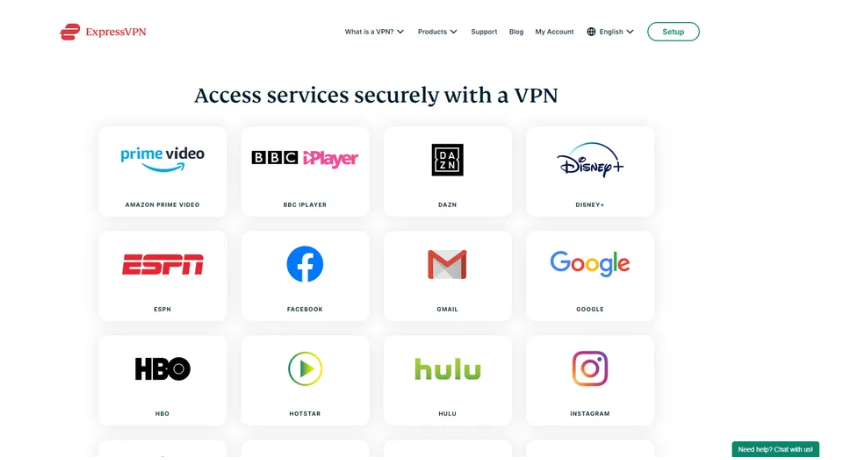
For streaming, ExpressVPN is about as close to reliable as this perpetually shifting category gets. Independent testing opened Netflix across several regions, including the German, Japanese, and US libraries, along with Disney+, Amazon Prime Video, BBC iPlayer, and Hulu, and on the rare occasion a server gets flagged, switching to another sorts it. I have watched more iPlayer from the wrong continent than the BBC would probably like, and ExpressVPN is the service that made it boring, which is the highest compliment you can pay a streaming VPN.
The hero for a lot of households is MediaStreamer, a smart-DNS feature that brings unblocking to the living-room kit no VPN app runs on, the smart televisions and the games consoles. Two caveats are worth knowing before you lean on it: it does not encrypt your traffic or hide your IP, so treat it as a convenience rather than a privacy tool, and once you are connected to the MediaStreamer DNS only US and UK locations are available, which is narrower than the full app. For getting a living-room TV onto a US or UK catalog without a router project, though, it is exactly the right tool, and it is the reason ExpressVPN sits high on my best VPNs for streaming list.
A little more on the services, since the experience differs across them. Netflix is the hardest gatekeeper and the one ExpressVPN handles most impressively, with testers logging into the US, German, and Japanese catalogs and connecting first time. Disney+ behaved the same way on US servers, every one tried working without complaint, and Prime Video serves up whatever catalog matches the server’s country. BBC iPlayer, which polices VPNs hard, has held up for me on UK servers more reliably than it does on several rivals. The one habit worth keeping is the universal one: if a title refuses to load, switch to another server in the same country before blaming the VPN, because it is almost always a single flagged server rather than the whole service going down.
Server network and China

ExpressVPN runs around 3,000 servers across 105 countries, which is a smaller raw count than some rivals but spread across more locations than most, so a nearby option is rarely far away. The TrustedServer RAM-only design covers the whole fleet, and a Smart Location feature picks the best server for you automatically, which is the kind of small touch that keeps the experience frictionless. It is breadth and reliability rather than a headline server number, and in daily use that is the trade that matters.
China comes up more than any other destination, and ExpressVPN is one of the rare names with a real record of working there. Its obfuscation makes the traffic look ordinary so it gets through the heavy filtering the Great Firewall throws up, and travelers keep reporting it holding a connection where rival services simply time out. The rule that never changes: get the app onto your devices before you fly, because the ExpressVPN site itself is often unreachable once you are inside the country. Conditions there change without warning, so I would carry a backup and test it from your hotel on day one, but as a candidate for the trip, ExpressVPN is near the front of a very short queue.
ExpressVPN on the road
Travel is where ExpressVPN’s polish stops being a nicety and starts being the reason to own it. The networks you meet on the move are hostile in mundane ways: captive portals that mangle connections, WiFi that drops every time you walk to the lobby, the occasional country that actively filters VPN traffic. Lightway’s habit of holding the tunnel through a network change is the thing I notice most, because it means a call or a download survives the walk from the room to the cafe rather than collapsing halfway. Add the consistency over long distances and ExpressVPN is the VPN I least often have to think about when I am away from home.
The harder environments show the difference more starkly. From a long stay in an apartment in Lisbon the encryption and the streaming were simply faultless, which is the easy case; the meaningful test is the genuinely restrictive country, and ExpressVPN’s record there is the best argument in its favour for anyone who travels widely. It is not infallible behind the most aggressive firewalls, and I would always carry a backup and test from the hotel on arrival, but if I could install only one VPN before a trip somewhere with heavy censorship, this is the one I would pick. For the frequent traveler specifically, the premium is easiest of all to justify, because the alternative to paying it is being stranded offline at the worst possible moment.
Torrenting and P2P
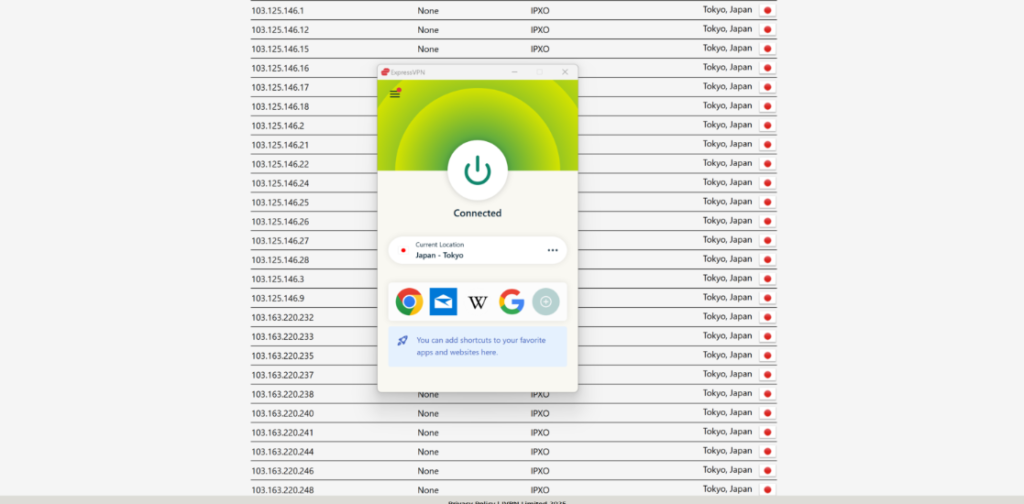
Torrenting is allowed on every server rather than penned onto a few, which keeps it simple, and the speeds hold up well enough that large downloads do not turn into an afternoon’s wait. Network Lock cuts you off the instant the connection stumbles, so your real IP stays clear of the swarm, and the no-logs policy, proven under that Turkish seizure, is exactly the backing the activity calls for. There is Tor support too for layering extra anonymity when you want it. ExpressVPN does not chase the torrenting-power-user crowd with port forwarding the way a couple of specialists do, so the most demanding downloaders may want one of those instead, but for the ordinary user who also torrents, it handles the job cleanly and quickly without asking anything of you, which is the recurring theme of the whole service.
The Tor support is a nice extra for the rare occasions you want it, letting you into the Tor network without firing up its dedicated browser, stacking that anonymity over the encrypted tunnel. And the speed genuinely matters for downloading, since a torrent that finishes overnight on a fast provider can drag into the next afternoon on a slow one; ExpressVPN’s consistency over distance means a swarm on the other side of the world stays usable rather than crawling. It will not satisfy the hardcore downloader who lives and dies by port forwarding, but for the large majority who torrent occasionally and want it safe and quick, it is more than enough, and the seizure-proven no-logs policy is the reassurance that the activity depends on.
Apps, everyday use, and support
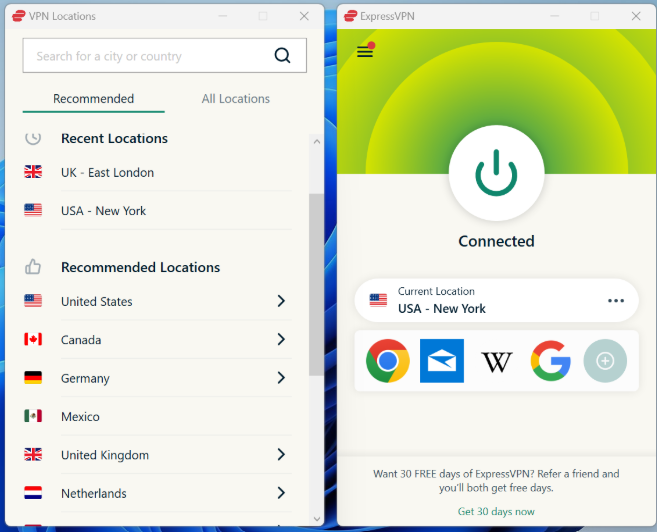
A good chunk of the price is earned right here. There are apps for Windows, macOS, iOS, Android, Linux, and Amazon Fire devices, plus proper router firmware and even a dedicated Aircove router if you want to protect a whole network at once. They are clean, quick to open, and forgiving of the impatient: getting connected to a fast server is one tap, and nothing about the experience makes you feel you need a manual. For someone who just wants protection without a hobby attached, that polish matters more than any feature list, and it is the single hardest thing for a rival to copy.
Device limits used to be ExpressVPN’s pettiest annoyance, and they have eased to around eight simultaneous connections depending on the plan, which is enough for most homes even if it still cannot match the unlimited devices a budget rival like Surfshark hands you. The polish runs deeper than first impressions, too. The apps look and behave the same across every platform, so the muscle memory carries from laptop to phone to tablet, and small touches like the one-tap Smart Location and a clean settings layout mean you rarely have to hunt for anything. For the household where one person sets things up for everyone else, that consistency turns support requests into two-minute calls. Speaking of which, support is the other half of the experience, a 24/7 live chat that has fixed my problems rather than read me a script, backed by a deep help center. You forget about support entirely until the evening before a trip when nothing will connect, and on that evening this is the kind you are grateful to have.
Whole-home coverage and the Aircove router
The eight-device limit is the one number that nags at a busy household, and ExpressVPN’s answer is the router. Installing it on a compatible router protects everything on the network through a single connection that counts as one device, which sidesteps the cap, and unlike most providers ExpressVPN also sells its own pre-configured router, the Aircove, so you do not have to flash firmware yourself to get there. For the living room especially, that is the cleanest route: the television, the console, and every smart-home gadget ride the protected connection without an app between them.
It is a telling detail about who ExpressVPN is for. A budget provider hands you unlimited connections and lets you sort the rest out; ExpressVPN keeps a tighter device limit but builds you a piece of hardware that makes the limit irrelevant and the setup effortless. That is the premium philosophy in miniature, paying a little more to have the awkward part solved for you, and for the household that would never willingly configure a router, the Aircove turns whole-home coverage from a project into a purchase.
Setting up ExpressVPN
Setup is about as painless as the category offers, as you would hope at this price. Register, download the app to your device, sign in with the activation code it hands you, and tap the big button; Smart Location picks a fast server and you are protected. If you want to tune it, the two settings worth a glance are Network Lock, which you should leave on, and the protocol, where Lightway is the right default for speed. For a smart TV or console, set up MediaStreamer through your account for US and UK streaming, or run the VPN on a compatible router or an Aircove to cover the whole house. Heading somewhere with heavy censorship? Install it before you travel, while the website is still reachable. My VPN setup guide covers each platform if you want the detailed walk-through.
ExpressVPN pricing and plans
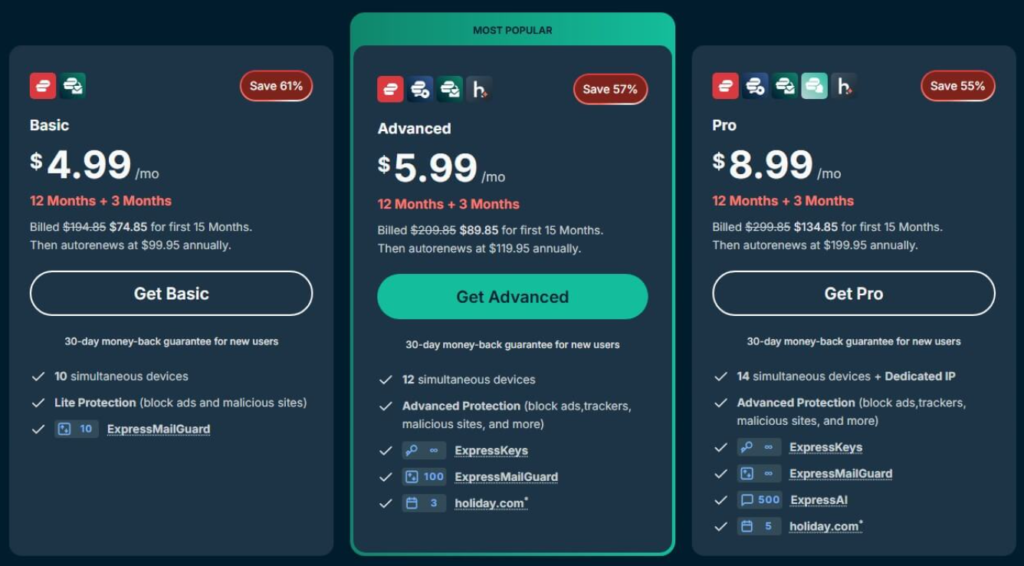
Pay month to month and ExpressVPN will relieve you of around $13, which is steep and always has been. The savings live on the long plans, and this is where the recent changes help most. The two-year plan, usually bundled with several free months, works out to roughly $2.49 a month, which finally puts ExpressVPN in shouting distance of the mainstream after years of being the expensive option by default. The subscriptions now split into Basic, Advanced, and Pro tiers, with the higher ones folding in extras like a password manager and identity-protection features, so you can take just the VPN or the wider bundle as you prefer. Whichever you choose comes with a 30-day money-back guarantee, and it is an honest one: buy the long plan, lean on it hard for a week, and claw the money back if it underwhelms. Even at the long-plan rate it costs more than the budget names, which is the trade you are knowingly making for the polish.
Worth a clear-eyed word on the renewal, as with the whole category: the advertised rate is the new-customer price tied to a long term, and it steps up once that term lapses, so a calendar reminder before the first renewal saves an unwelcome surprise. The tiered plans are also worth thinking through rather than defaulting to the top one. The bare VPN on the Basic tier is all most people need, and the password manager and identity tools on the higher tiers are only worth the step up if you do not already have them elsewhere; paying for a second password manager you will not use is the easiest way to overspend here. Take the cheapest tier that covers what you lack, on the longest term you are comfortable committing to, and the value holds up far better than the monthly sticker suggests.
| Key facts | ExpressVPN |
|---|---|
| Price | Around $2.49/mo on the 2-year plan (plus free months); ~$13 month-to-month |
| Money-back guarantee | 30 days |
| Simultaneous devices | About 8 (varies by plan) |
| Servers | 3,000+ in 105 countries (company figure), RAM-only |
| Jurisdiction | British Virgin Islands (Kape Technologies) |
| Protocols | Lightway, OpenVPN, IKEv2 |
| Encryption | AES-256 / ChaCha20, Perfect Forward Secrecy |
| Logging | No-logs, seizure-proven and independently audited (KPMG, Cure53) |
| Streaming | Netflix, Disney+, Prime Video, Hulu, BBC iPlayer; MediaStreamer for TVs |
| China | Works, with a track record |
Try any plan for 30 days and refund it if it disappoints.
What is new for 2026
ExpressVPN’s recent changes are unusually substantive for a mature product. The biggest for buyers is the pricing: the long-term plans have come down far enough, often paired with several free months, that the old “great but too expensive” verdict no longer holds the way it did. On the technical side, the Rust rewrite of Lightway is the headline, making the protocol leaner and easier to audit, with post-quantum protection added on top. The tiered Basic, Advanced, and Pro plans are newer too, letting you take the bare VPN or a wider bundle with a password manager and identity tools. And the audit cadence has kept up, with the 2025 KPMG assessment of the TrustedServer controls the most recent of a long run. None of it changes the core character, the frictionless premium VPN, but it answers the two complaints that used to define the conversation: the price and, for the technically minded, the closed nature of the old protocol.
How ExpressVPN compares
Two rivals come up every time. NordVPN is the nearest match on speed and features, just as quick and arguably deeper on extras while costing a little less, so picking between them usually turns on which app you find friendlier and whether Nord’s bigger toolkit appeals more than Express’s slightly cleaner feel; I weigh them in full in my NordVPN vs ExpressVPN comparison. Surfshark attacks from the budget side, with unlimited devices for around a third of the spend, and for a household watching every pound it is the smarter buy even with a small drop in long-haul speed and polish. And for the buyer whose first concern is privacy you can independently verify, ProtonVPN’s Swiss base is the alternative to weigh. ExpressVPN’s argument is not that it tops every category; it is that it makes you give up fewer of them than anything else, and the price is the cost of that.
Where ExpressVPN falls short
The shortcomings are few and well known. Price leads the list: even after the long-plan cuts, ExpressVPN asks more than the budget and mid-tier names, and if money is the deciding factor that gap is real and the value rivals are a perfectly rational choice. The Kape ownership is the second, less a present-day fault than a piece of context the privacy-minded will want to settle for themselves. And the roughly eight-device limit is tighter than the unlimited crowd, which a big household will feel the moment the ninth gadget needs covering.
Weighed against that is a service with remarkably little to apologise for: speed that holds across oceans, security proven under an seizure and confirmed by name-brand auditors, streaming that just works, a real China record, and apps so smooth they are why I recommend it to people who hate technology. The limits do not sink ExpressVPN for the buyer who wants the smoothest ride over the cheapest, or it would not have held its place near the top of my picks. But a review that tucked the price behind the polish would be useless to you, because the price is exactly the thing you have to decide you are willing to pay.
ExpressVPN FAQ
Is ExpressVPN worth the higher price?
For the buyer who values a frictionless, reliable experience over saving money, yes. You are paying for the fastest-feeling protocol, the most polished apps, excellent support, and a security record proven under a real server seizure. If price is your main concern, NordVPN or Surfshark give you most of the capability for less.
Is ExpressVPN safe and private?
Yes. The encryption is strong, every server runs from RAM under TrustedServer, and the no-logs policy held up when Turkish investigators seized a server in 2017 and found nothing on it. Outside audits, including a 2025 KPMG review, have since backed the claim. The one thing to weigh is the Kape Technologies ownership.
Does ExpressVPN work with Netflix?
Reliably, and across many regions. Independent testing opened the US, German, and Japanese Netflix libraries among others, plus Disney+, Prime Video, Hulu, and BBC iPlayer. On a television or console that has no client of its own, MediaStreamer covers US and UK streaming.
Does ExpressVPN work in China?
It has a genuine track record there, which most VPNs cannot claim. Its obfuscation slips past the Great Firewall for many travelers, but install the app before you arrive, since the website may be blocked once you land, and carry a backup because conditions change without warning.
What is Lightway?
Lightway is ExpressVPN’s own protocol, rebuilt in the Rust language for memory safety, with an open-source core and post-quantum protection. It connects in about a second and stays stable as you move between networks, which is the main reason the service feels so quick in daily use.
How many devices can I use with ExpressVPN?
Around eight simultaneous connections, depending on the plan, which is enough for most households. If you need to cover more at once, a provider with unlimited connections like Surfshark, or running ExpressVPN on a router, is the way to go.
What is TrustedServer?
TrustedServer is ExpressVPN’s RAM-only server technology. Because the servers run entirely from memory and write nothing to a hard drive, every reboot wipes them clean and there is no stored data to seize or hand over, which is what made the 2017 Turkish seizure come up empty.
Does ExpressVPN have a kill switch?
Yes, called Network Lock. It cuts your internet the instant the VPN connection drops, so your real IP cannot leak in the gap before it reconnects. In my testing it fires when it should rather than a beat late, and it is on by default, which is how a kill switch ought to ship.
Is ExpressVPN good for gaming?
Yes, on a server near you. Latency stays low enough for online play to feel normal, and Lightway keeps the connection stable. No VPN beats a direct connection on latency, but ExpressVPN comes closer than most and can help by routing around an internet provider that throttles game traffic.
Is there a free trial?
Short trials appear on mobile via the app stores, and the 30-day money-back guarantee on every plan amounts to a risk-free month: pay, run it through real use, and ask for your money back before the window closes if it disappoints.
Does ExpressVPN slow down your connection?
Very little, and less than most over distance. Independent testing kept a 250 Mbps line in the 240s on close servers and the 190s to 220s far afield, against the roughly 20 percent drop even fast VPNs post locally. The Lightway protocol is the reason it stays so quick.
Is ExpressVPN owned by Kape Technologies?
Yes, since 2021. Kape’s past has drawn scrutiny from some privacy advocates, so it is worth knowing. The counter is that the independent audits have kept coming since the acquisition and the no-logs policy survived a real server seizure, so the technical record is strong regardless.
Can I use ExpressVPN on my TV?
Yes. Fire TV and Android TV both have native apps, and for a set without one, MediaStreamer opens US and UK streaming over smart DNS. You can also run ExpressVPN on a compatible router or its own Aircove router to cover the television through the network.
Verdict: who should buy ExpressVPN
Buy ExpressVPN if you want the smoothest, most reliable VPN experience and you are willing to pay a premium for it. It is the pick for frequent travelers, fuss-averse streamers, and anyone who would rather spend a little more than troubleshoot at all, and the new long-term pricing has taken much of the sting out of the cost. The speed holds across oceans, the security has been proven the hard way, and the apps are the reason it is the VPN I hand to people who hate technology.
Look elsewhere if value is the deciding factor: NordVPN matches most of the experience for less, Surfshark undercuts everyone with unlimited devices, and ProtonVPN is the stronger pick if a Swiss base with no corporate baggage is your hard requirement. For everyone who simply wants the thing to work, every time, without a second thought, ExpressVPN remains one of the safest calls in 2026, and you can size it up beside the rest on my best VPNs of 2026.
If that trade sounds like the one you want to make, this is the one I would buy without a second thought. Take the two-year plan for the best rate, give it a week of real use, and lean on the 30-day guarantee if it does not win you over. The premium is real, but so is the quiet that comes from never having to think about your VPN again.
One last way to frame the decision, since it really does come down to a single question. If you would happily spend an evening tinkering to save a few pounds, ExpressVPN is not your best value, and I have named the cheaper providers that will serve you well. If your reaction to “spend an evening troubleshooting” is that your time is worth more than that, then the premium is not really a premium at all; it is the price of getting that evening back, every time something would otherwise have gone wrong. Which of those two people you are settles the whole review, and ExpressVPN has spent years making sure that, for the second one, there is very little left to think about.
30-day money-back guarantee, cancel anytime.
Leave a Reply
You must be logged in to post a comment.