

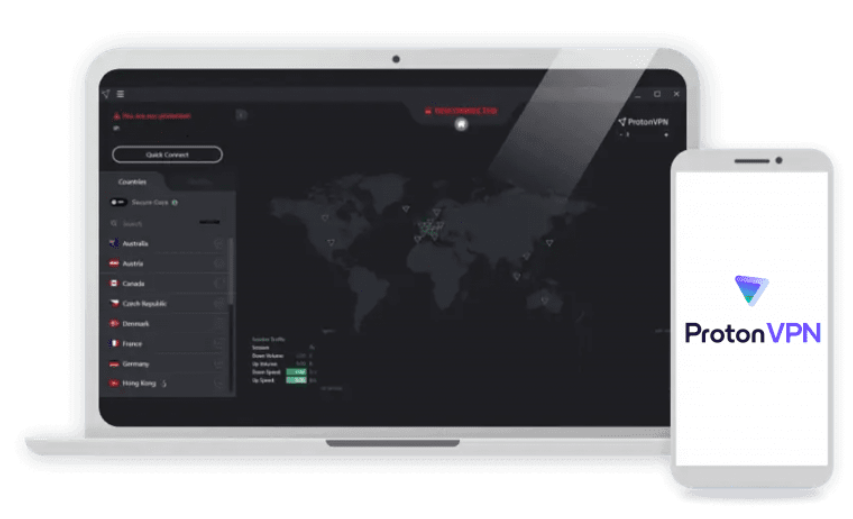
There is exactly one free VPN I will tell you to install without a knot in my stomach, and ProtonVPN is it. That sentence is doing a lot of work, because the free VPN market is mostly a swamp of data harvesting, and Proton walks out of it clean. Heading into 2026 it is the most transparent VPN you can put your trust in: Swiss by jurisdiction, open-source on every platform, audited year after year, and built by the same people behind Proton Mail. My rating: 4.6 out of 5.
Here is my conclusion before the detail. If privacy is the reason you are shopping for a VPN at all, this is the first name I would point you to. Proton concedes a little ground on streaming polish and on the lowest sticker price, but at the job it sets out to do, protecting your traffic and being able to prove the claim, nothing else in my lineup is this convincing. What follows is the case for that, and the places it falls short, because a privacy tool you cannot interrogate is not one worth trusting in the first place.
Free tier available, or a 30-day money-back guarantee on the paid plans.
Table of Contents
ProtonVPN at a glance
Proton earns a particular kind of respect, the sort you extend to a service that keeps doing the unglamorous things right. Here is where it shines and where it asks for patience.
What it gets right:
- A free plan with unlimited data, no ads, and no logging, which barely exists anywhere else.
- Swiss jurisdiction, beyond the reach of the Western intelligence-sharing alliances.
- Apps that are open-source top to bottom, so the code can be inspected rather than trusted blind.
- A no-logs policy audited several years running by an independent firm.
- Heavyweight privacy tools: Secure Core, NetShield, built-in Tor routing, and the Stealth protocol.
What I would change:
- Streaming works well on the paid plan but takes a touch more effort than the dedicated streaming names.
- It is not the most dependable choice inside the harshest censorship, China included.
- The free servers can slow to a crawl when they are busy.
The free plan that is truly worth using
Let me start where Proton is most unusual. Almost every free VPN pays its bills by selling the very thing you installed it to protect, or by throttling you so hard that the upgrade button becomes the only way to breathe. Proton’s free plan does neither. You get unlimited data, no advertising, and no logging, on a handful of country servers, for one device at a time. The catch is speed and choice: the free locations are limited and they slow down under load. But it is a free VPN you can hand to your least technical relative without a second thought, and that group has almost no members.
It also works as a clean on-ramp. Start on the free tier, get comfortable with the app, and if you outgrow it the upgrade is one tap away with no new brand to learn and no account to migrate. I send a lot of people here when they tell me they are not sure they need a VPN yet; the free plan lets them find out at no cost and no risk. The wider case for why the rest of the free market is a minefield, and why Proton is the exception, is laid out in my free versus paid VPN guide.
What the free plan feels like in daily use is worth spelling out, because it sets expectations. You are connecting through a small set of countries rather than the full map, and the single-device limit means choosing which gadget gets the protection, usually the laptop when I am traveling light. On a evening it is perfectly quick for browsing and email; at a busy hour the shared free servers can drag, which is the gentle nudge toward upgrading without Proton ever crippling the thing to force your hand. That restraint is the part I respect most. The free tier is allowed to be genuinely good, because Proton makes its money when you decide the paid network is worth it, not when it makes the free one miserable enough to push you there.
Free versus paid: what you get
Because the free plan is such a draw, it is worth being precise about where it stops and the paid plan starts, so neither one surprises you. The free tier delivers the core promise, encrypted traffic and no logging, but it is fenced in on purpose: one device at a time, a small handful of country locations, middling speeds that sag when those servers fill, and none of the heavier tools. There is no P2P, no Secure Core, no NetShield, and it will not dependably open streaming catalogs. Treat it as a genuine, usable VPN for everyday browsing and public-WiFi safety rather than a crippled trial, but understand it is a floor, not the whole house.
VPN Plus is what unlocks the Proton I rave about. The device cap rises to ten, the entire network opens with its thousands of servers and tagged specialty locations, and the security shelf fills out with Secure Core, NetShield, Tor routing, and Stealth. Streaming turns genuinely workable through the labeled servers, and torrenting gains P2P support and port forwarding. For most people the upgrade pays for itself the first time they want their home Netflix from another country or a second device covered, and at roughly three dollars a month on the long plan, the sum is not a hard one to do. The free tier is the invitation; the paid tier is the product the invitation is for.
Privacy: the Swiss base, the audits, and the Proton Mail case
Privacy is the whole reason Proton exists, so this section carries the weight of the review. The company is headquartered in Geneva, under some of the strongest privacy law in the world and well outside the major intelligence-sharing alliances. It records no activity, and instead of asking you to believe that on faith, it pays an independent firm to verify the claim year after year and publishes the findings in the open. Securitum has run that check more than once, the latest report posted on Proton’s own audit blog. Every Proton app is open-source as well, so any researcher can read the code line by line rather than trust a marketing page.
One case comes up every time I recommend Proton, the 2021 court order, so let me put it on the table rather than hope it slips by. It involved Proton Mail, not the VPN: Swiss authorities served a valid legal order and forced Proton to begin logging activity on a single email account. It happened, and Proton has been candid about it. The distinction that matters here is that Swiss law does not oblige ProtonVPN to log your connections, a point the company has stated plainly. Proton also issues a regular report on the legal demands it receives, which is the kind of openness I want from anyone routing my traffic. None of it shifts my conclusion. For privacy you can genuinely verify rather than hope for, Proton is the strongest name in this field, and it leads my best VPNs for privacy list.
The reason all of this matters is that trust in a VPN is mostly unprovable. You are routing every byte you send through someone else’s servers, and almost every provider asks you to take their good intentions on faith. Proton has spent years replacing faith with evidence, piece by piece, and that accumulation is the product. It is not the flashiest pitch on a sales page, but it is the one that should move you.
How I judge a privacy-first VPN
To show my working on Proton, here is the lens I hold a privacy VPN up to, because it is a different test from the one I apply to a streaming or budget pick. The first question is jurisdiction: where the company is registered decides what a government can compel it to do, and a base outside the major intelligence alliances starts the argument in your favor. The second is proof rather than promises. Anyone can type “no logs” on a sales page; the providers I trust pay outsiders to check the claim and publish what they find, and they open their code so the check is more than theater. The third is the response to pressure, the rare moment a company is pressured, because that is when you learn whether the policy is real or decorative.
I also run the unglamorous mechanical tests, the leak checks that confirm your DNS requests and real address are not slipping out around the tunnel, and I live with the thing across the kind of patchy hotel and café connections that expose a flaky kill switch. Proton clears every one of those bars, which is rarer than it ought to be, and it is the reason I weigh it the way I do. A provider can be fast and slick and still fail the only test that matters for this category, which is whether you can verify it is doing what it claims. Proton can, repeatedly, and on the record.
Security features built for the privacy-minded
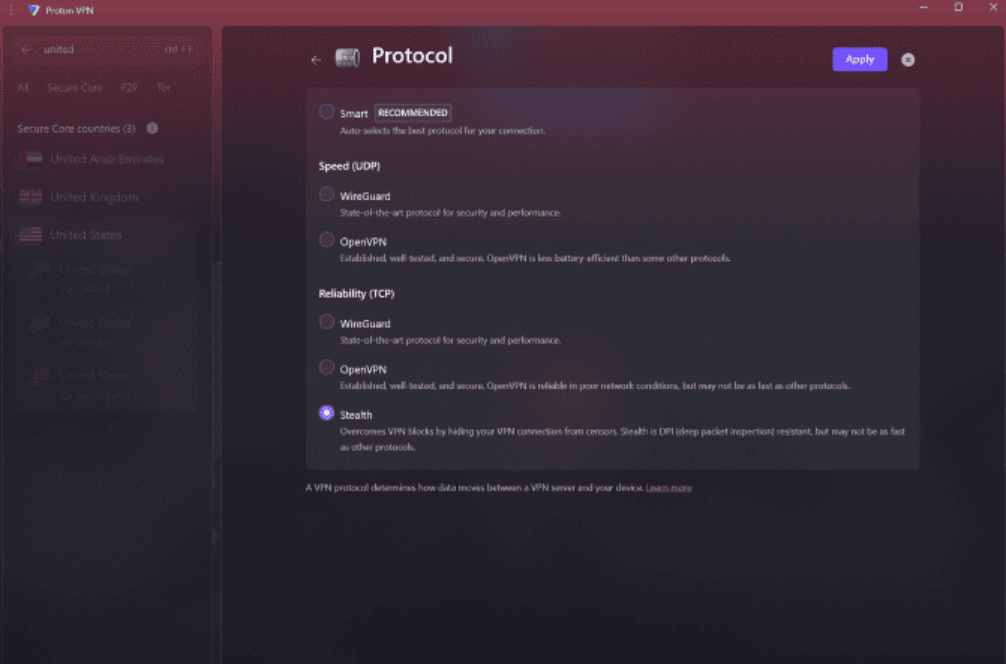
Proton’s toolkit is aimed at people whose worries run deeper than dodging a geo-block, and it is the most genuinely security-focused set in this roundup. The encryption underneath is current and uncompromising, and the defaults are set correctly so you never have to think about it, but the features stacked on top are where Proton pulls away from the pack.
Secure Core and NetShield
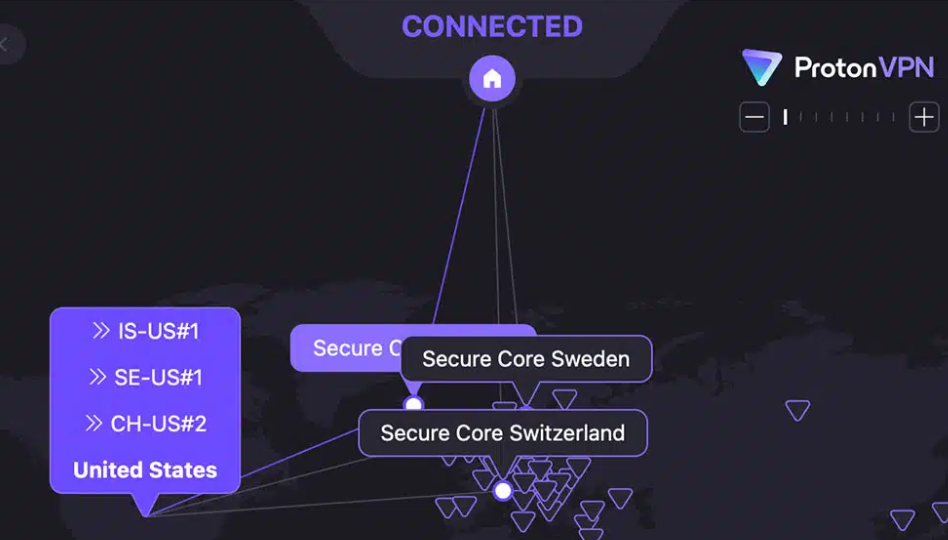
Secure Core is the headline. It routes your traffic through hardened servers in privacy-friendly countries, Switzerland, Iceland, and Sweden, before the connection ever leaves Proton’s network, so a server that is somehow compromised at the exit never learns where you started. Most people will not need that extra hop, and a few people need it badly, which is exactly who Proton builds for. To be clear about who that is: if your worry is an internet provider logging your browsing or a snoop on the café WiFi, the standard connection already covers you, and Secure Core is overkill. If your worry is a well-resourced adversary who might compromise a server to unmask you, the multi-hop design is built precisely for that threat, and almost no rival offers anything like it. NetShield is the everyday companion, a DNS-level blocker for ads, trackers, and malware that you can dial from off, to malware-only, to the full block, and it runs quietly once you set it, trimming page clutter and shaving a little data off every mobile session in the bargain.
Tor over VPN, the kill switch, and Stealth
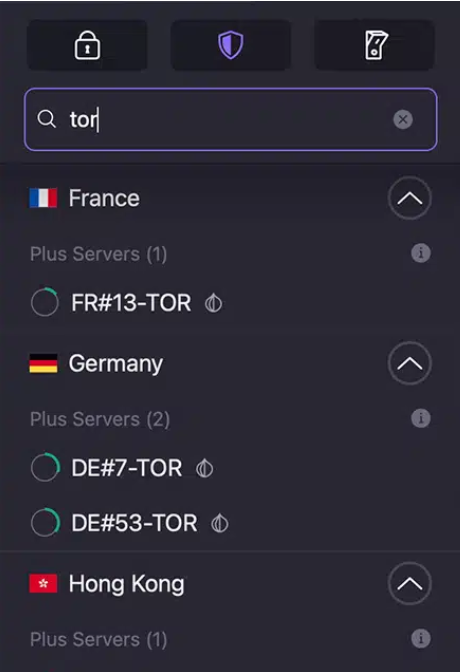
There is Tor routing baked in, so you can reach the Tor network without firing up a separate browser, which is a genuinely handy shortcut for the odd moment you want it. The kill switch can be set to permanent, sealing your connection shut even across a reboot, and in independent leak testing Proton comes back clean on DNS and WebRTC, matching what I find when I check it. The piece I lean on most when traveling is Stealth, Proton’s protocol that disguises VPN traffic as ordinary traffic; on a network that blocks everything else, it is often the only thing that still gets through.
Speed and the VPN Accelerator
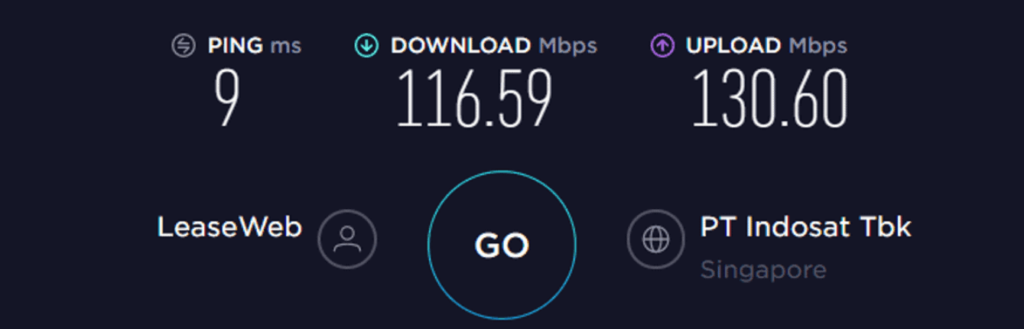
Proton used to wear a reputation for being slow, and it has outrun that label. The paid network is quick in the places that matter. On a close server I get speeds I have no complaint about for 4K streaming, large downloads, and video calls, and the connection rarely makes itself felt. Part of the reason is a feature Proton calls VPN Accelerator, a set of network optimizations the company says can lift speeds substantially on longer routes; it lives in the app settings and is on by default.
The measured results agree with the seat-of-the-pants read. In testing, a connection running near 930 Mbps without the VPN held around 850 Mbps through a Proton server, roughly nine-tenths of the line, with latency creeping up by a single millisecond. That is a small toll for the protection, and it tracks with my own day-to-day use of the paid plan. The one place speed genuinely sags is the free tier, where the limited servers can choke at peak times, so if raw pace is your top priority, the paid network is the one to judge Proton on. For the speed-versus-privacy trade against a faster rival, my ExpressVPN vs ProtonVPN comparison lays it out in full.
Streaming with ProtonVPN
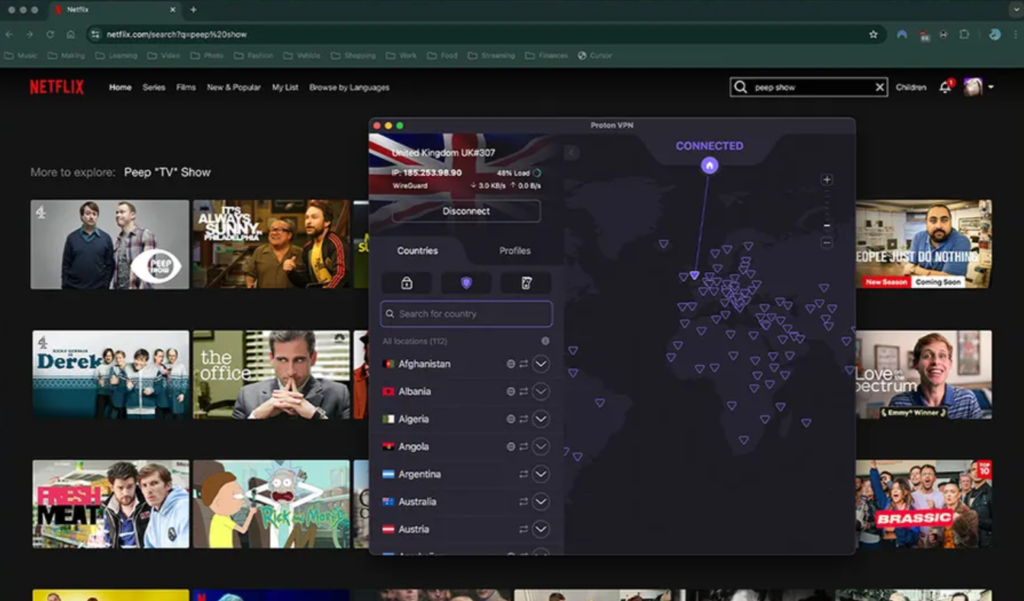
Streaming is the softer side of Proton, though it has come a long way and now holds up better than its reputation suggests. On the paid plan, the app marks certain servers as Plus servers tuned for streaming, so you are not guessing which one will get you in. In testing, Proton opened Netflix in the United States, Canada, the United Kingdom, and Australia, and in my own use Disney+ and a handful of others have loaded cleanly too. BBC iPlayer, which is notoriously strict, has loaded for me on UK servers far more often than it has balked, and that alone puts Proton ahead of several larger rivals on the channel.
The framing is one of degree. Proton streams well, but it asks for a little more patience than a streaming-first service that labels a server for every channel, and the free tier will barely unblock anything at all, which is by design. If watching geo-locked catalogs is the single reason you want a VPN, there are smoother picks higher on my best VPNs for streaming list. If streaming is a welcome bonus on top of a privacy tool you trust, Proton handles it better than you might expect from its serious reputation.
A few specifics, since the experience varies by service. Netflix is the standout, with that four-region result in independent testing matched by my own switching between US and UK catalogs without the dreaded proxy error. Disney+ has been dependable on the labeled servers, and Amazon Prime Video gives you whatever catalog matches the server’s country. The services that ask for the most patience are the ones everyone struggles with, the aggressively VPN-hostile platforms where you may have to hop across a couple of streaming-tagged servers before one sticks. And the same fix applies here as everywhere: a catalog that refuses to load is almost always a single overworked server, so try another Plus server in the same country before you write Proton off.
Server network and restrictive countries
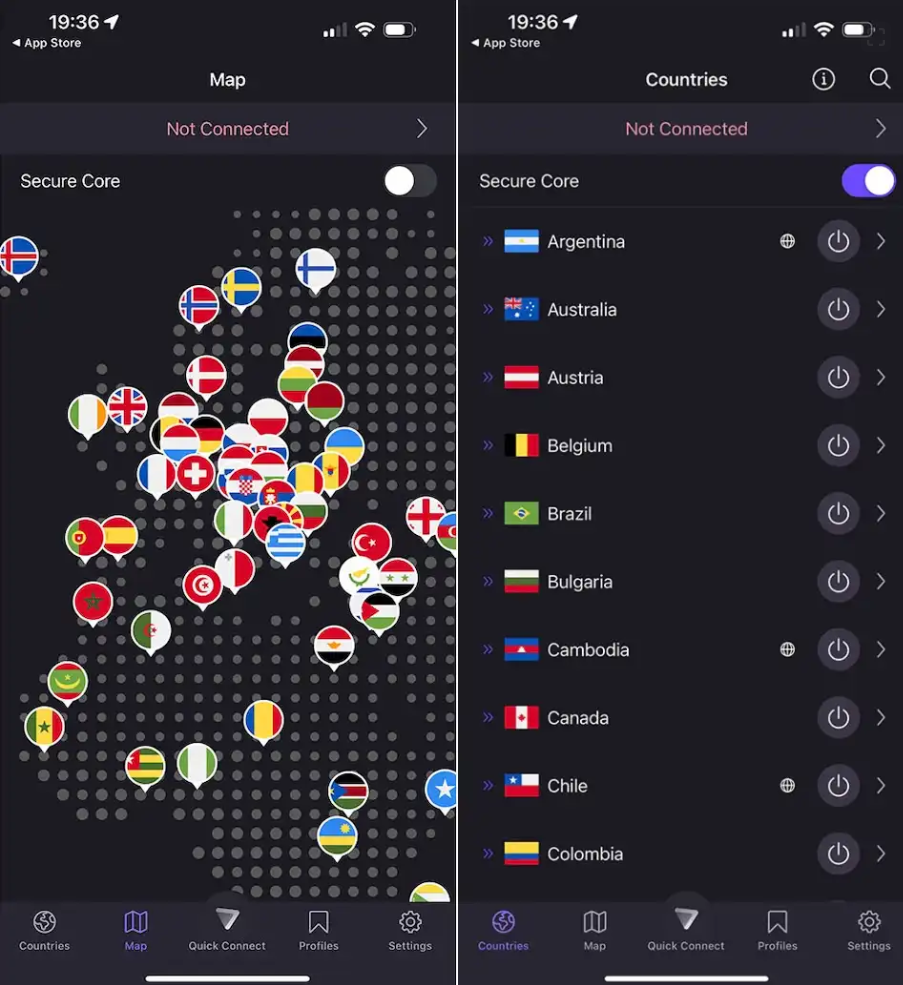
On paper the network is large. Proton advertises servers numbering into the tens of thousands across more than 140 countries on the paid plans, with locations tagged in the app for their best use, whether that is streaming, P2P, Tor, or Secure Core. The exact server count moves around with every press release, but the practical upshot is steady: I can always find something nearby and something believable far away, and the specialized tagging takes the guesswork out of picking one.
That tagging is more useful than it sounds, because Proton sorts its servers by job rather than leaving you to guess. Streaming-optimized servers are marked for the catalogs they handle, P2P servers are flagged for torrenting, Tor servers route you into the onion network without a separate browser, and the Secure Core locations sit in their own group for the days you want the extra hop. There is also the free pool, deliberately kept separate so the paid network is not dragged down by it. The upshot is that you waste less effort searching for the server that does what you need and spend more of it connected, which is exactly the sort of small, practical polish a mature service accumulates over years.
On the harshest censorship, Proton is open about being a work in progress, and so will I be. Testing found it does not consistently get through inside mainland China, where a few rivals with heavier obfuscation hold a steadier record. The Stealth protocol and alternative routing help on most filtered networks, and I have leaned on them successfully in more than one country that blocks ordinary VPN traffic, but China specifically is the place I would not stake a trip on it. For everywhere short of that, restrictive offices, hotel portals, and the like, it copes without fuss.
Proton on the road
Where Proton has won me over is travel, which is the situation that exposes a VPN’s weak points fastest. Hotel and café networks are a menagerie of captive portals, aggressive filtering, and connections that drop the moment you carry your laptop to the lobby, and a privacy tool that buckles under any of that is no tool at all. Proton’s Stealth protocol is the piece I reach for here, because by dressing the traffic up as ordinary web traffic it slips past the filters that block plain VPN connections, and the permanent kill switch means a flaky signal never leaves me exposed between reconnects.
In a coworking space in Istanbul with the sort of filtering that swats most VPNs on sight, Stealth was what stood between a usable connection and a blank browser window, and it has pulled the same trick for me on more than one locked-down hotel network since. That is the everyday version of the privacy Proton sells: not cloak-and-dagger drama, but a connection that keeps working and keeps you covered in the unglamorous places where lesser apps give up. The one exception I keep returning to is China, where even Stealth is not a sure thing and I would carry a backup. For the rest of the difficult-network world, Proton is among the steadier companions I have traveled with, the sort of tool whose worth only lands on the night nothing else will connect.
Torrenting and gaming
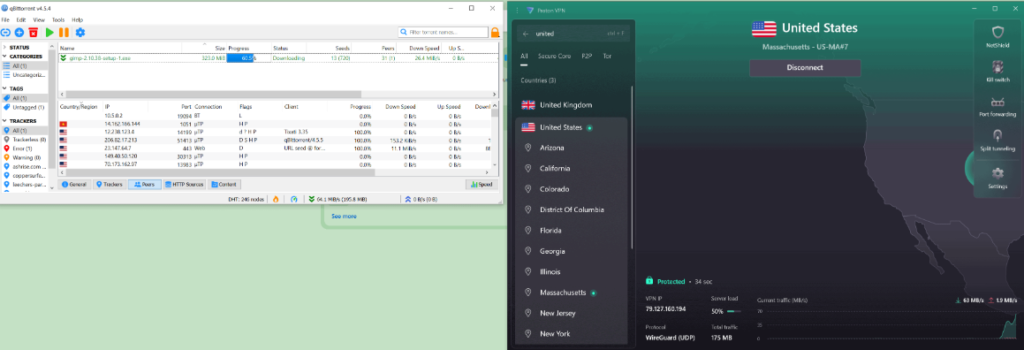
Torrenting is well handled on the paid plans, with P2P-friendly servers and port forwarding for anyone who wants better connectivity to peers. Pair that with the no-logs policy and the Swiss base and you have a torrenting setup that takes the worry out of it, which is why Proton sits comfortably on my best VPNs for torrenting list. The free tier does not support P2P, so downloaders want the paid plan here. Gaming is a similar story: latency on a nearby paid server stays low enough for online play, while the free servers are too slow to bother with. Neither is the headline Proton sells, and both are perfectly solid, which is the right shape for a tool built around privacy first.
For torrenting specifically, the combination that matters is the audited no-logs policy, the Swiss base, and port forwarding working together: your activity is not recorded, no friendly jurisdiction is positioned to demand it, and the connection to peers is healthy enough that large files do not crawl. I have set big transfers going on a P2P-tagged server and walked away for the night without a flicker of worry, which is the only real test of whether a torrenting setup deserves your trust in the first place. The kill switch is the backstop, cutting the connection if the tunnel ever drops so nothing escapes in the gap. It is an excellent torrenting VPN that does not market itself as one, which is rather on brand for a company that has always preferred to let the substance speak for it.
Who ProtonVPN is for
Picture the user Proton fits best. Someone for whom privacy is not a feature on a checklist but the reason they are here: a journalist protecting a source, an activist in a difficult place, or simply a person who has decided their browsing is nobody else’s business and wants a provider that can prove it keeps the bargain. For that user, the Swiss base, the annual audits, and the open-source apps are not marketing bullet points, they are the entire purchase.
It also suits the cautious newcomer perfectly, the person who wants to try a VPN without spending anything and without being farmed for data in the process. They can start free, trust what they are using, and grow into the paid plan when they are ready. The user Proton does not fit is the one whose single priority is effortless streaming, the cheapest possible sticker, or rock-steady access inside China; for them, a different name on my best VPNs of 2026 will land better, and that is a fair trade rather than a failing.
To make it concrete, here is the person I most often steer toward Proton: someone who has read one too many stories about data brokers and decided they have had enough, and who wants a VPN they will not have to take on faith. They are not necessarily technical, and they are not running from anyone in particular; they have simply concluded that privacy is worth a few dollars a month and they would like the few dollars to go to a company that has earned the trust rather than just claimed it. For that buyer, the audits and the open-source apps are not abstractions, they are the reassurance that lets them stop thinking about it, which is the whole point of buying a tool like this in the first place.
There is also another group Proton serves well: people who already use Proton Mail and want the rest of their digital life under the same roof. For them the VPN is less a separate purchase than the natural next room in a house they already trust, and the Unlimited bundle makes adding it close to painless. If you are in that camp, the decision is easier than for anyone else, because you have already made the harder call about whether you trust the company behind it.
The apps, platform by platform
Proton’s apps cover Windows, macOS, iOS, Android, Linux, and the major browsers, and the open-source policy holds across all of them, which is rare enough to be worth saying twice. They carry a little more on screen than a bare budget app, because there is more to offer, but nothing important is buried. A quick tour of how each lands:
- Windows and macOS expose the full kit, Secure Core, NetShield, the protocol picker, and the permanent kill switch among it.
- Android and iOS open to a one-tap connect and keep the headline features close, with split tunneling on Android.
- Linux gets a properly maintained, command-line-friendly client, which plenty of providers cannot be bothered to offer.
- Browser extensions cover lightweight, in-browser protection for the moments the full client is overkill.
Support is the one area where Proton trades convenience for its security-first instincts. There is no around-the-clock live chat; instead you get a ticket system and a thorough knowledge base. It is slower than instant chat, and the answers I have received were accurate and complete rather than a script read back at me. If you are setting up your first VPN, my VPN setup guide covers the opening steps on any platform.
Setting up ProtonVPN
Getting going is quick on either plan. Make a Proton account, which doubles as your login for Mail and the rest of the suite should you ever want them, install the client on your device, sign in, and connect. On the free plan that is the entire job. On the paid plan it is worth a two-minute detour through the settings: set the kill switch to permanent so a dropped tunnel never leaves you bare, turn NetShield up to block ads and trackers, and if you are heading somewhere that blocks VPNs, switch the protocol to Stealth before you travel rather than after you are stuck behind the wall. Secure Core sits on the profiles tab for the days you want the extra hop. None of it is required, since the defaults are already sound, but Proton rewards a little curiosity more than most apps do. If this is your first VPN, my VPN setup guide covers the groundwork on every platform.
ProtonVPN pricing and plans
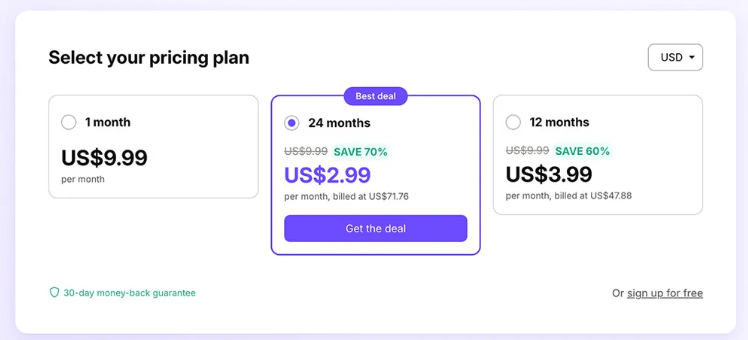
The pricing ladder starts at nothing. The free plan costs zero and asks only for an email. The paid tier, VPN Plus, works out to roughly $2.99 monthly across a two-year commitment and opens up the full network, the streaming servers, Secure Core, P2P support, and ten simultaneous devices. Above that sits Proton Unlimited, a bundle that folds in Proton Mail, Drive, Calendar, and the password manager, which is a strong deal if you were going to pay for private email and storage anyway. The paid plans carry a 30-day money-back guarantee, prorated to what you have used. Payment runs through the usual cards and PayPal, with options for anyone who would prefer not to attach their name to the subscription.
| Key facts | ProtonVPN |
|---|---|
| Price | Free tier, or VPN Plus from about $2.99/mo (2-year) |
| Money-back guarantee | 30 days (paid plans) |
| Simultaneous devices | 10 (paid), 1 (free) |
| Servers | Tens of thousands across 140+ countries (company figure) |
| Jurisdiction | Switzerland |
| Protocols | WireGuard, OpenVPN, IKEv2, Stealth |
| Encryption | AES-256 |
| Logging | No-logs, audited yearly by Securitum; open-source apps |
| Streaming | Netflix, Disney+, BBC iPlayer (paid plan) |
Start free, or get the full network with a 30-day money-back guarantee.
The Proton ecosystem behind the VPN
Something worth grasping about ProtonVPN is that it is not a lone product chasing a quick subscription; it is one limb of a privacy company. The same Geneva outfit makes Proton Mail, the encrypted email service it is best known for, plus Proton Drive for encrypted storage, Proton Calendar, and Proton Pass, its password manager. That matters on two fronts. The first is motive: a company whose whole business is privacy has a structural reason to keep the VPN clean, because a logging scandal would poison every other product it sells. The second is value, since the Proton Unlimited bundle gathers the VPN and all of those services under one subscription, and if you were already paying for private email or a password manager elsewhere, the sum can tip the entire suite into costing less than the parts.
You do not have to buy into any of that to use the VPN, and plenty of people take VPN Plus and never open the rest. But the ecosystem is part of why I trust the VPN further than I would a single-product startup. The reputation Proton built with Mail, among journalists and activists who stake real risk on it, is the reputation the VPN inherits, and a company with that much to lose has every reason not to cut a corner where your traffic is concerned.
What is new for 2026
Proton has not been coasting. The network has kept expanding, both in raw count and in the spread of specialized streaming and P2P locations, and VPN Accelerator has been refined to claw back more speed on the long international routes where VPNs usually fade. The apps have had steady usability work, sanding down the rough edges that once made the desktop client feel more like an instrument than a product. Stealth has widened its reach on hostile networks, and Proton has kept pushing on forward-looking encryption to keep the tunnel sound against threats that are still over the horizon. None of this rewrites what Proton is, a privacy-first VPN that asks to be checked rather than believed, but it is the sort of steady effort that signals a company still serious about the thing it sells.
How ProtonVPN compares
Held up against the speed-and-streaming crowd, Proton swaps a little convenience for a lot of provable privacy. ExpressVPN is faster and slicker at unblocking, and I weigh the two philosophies directly in my ExpressVPN vs ProtonVPN comparison. Surfshark costs less and lifts the device limit entirely, but it cannot match the Swiss jurisdiction and the run of yearly audits. NordVPN is the smoother all-rounder for the average buyer who wants one VPN to do everything. Proton wins outright on one axis alone, the ability to check its claims instead of trusting them, and for a large slice of buyers that is the axis that settles everything else.
Reliability and the honest limits
After years of leaning on Proton, the rough edges I would flag are few but real, and you deserve them before you commit. The free servers are the obvious one: when they fill up, the speed falls far enough to feel, which is the price of a free tier that refuses to earn its keep the usual grubby way. Support is the other, since the ticket-and-knowledge-base model is slower than the instant live chat the big commercial names staff around the clock, and on a bad night that wait can grate when you just want the thing fixed.
The remaining ones are matters of degree rather than faults. Streaming asks for a touch more patience than a service built only to crack catalogs. China stays the single place I would not gamble a trip on it. And the app shows a little more on screen than a stripped budget client, which is the natural cost of having Secure Core, NetShield, and the rest to put in front of you. None of these sink Proton for the user it is meant to serve, or it would not hold the place it does on my lists, but a review that tucked them out of sight would be writing the company’s advertising instead of doing your homework.
ProtonVPN FAQ
Is ProtonVPN’s free plan really free?
Yes, properly free. The plan has unlimited data, no ads, and no logging, on servers in a few countries for one device. The trade-offs are middling speeds and limited locations, not hidden data harvesting, which is what makes it the one free VPN I recommend without hesitation.
Is ProtonVPN trustworthy?
It is the most verifiable name in this lineup. It is based in Switzerland, keeps no activity logs, publishes open-source apps, and has had its no-logs policy independently audited several years in a row by Securitum. It also issues a transparency report on the legal requests it receives.
What about the 2021 Proton court case?
That case concerned Proton Mail, not the VPN. Swiss authorities served a valid legal order compelling Proton to log activity on one email account. Proton has been clear that Swiss law does not require it to log VPN connections, so the case does not undermine the VPN’s no-logs position.
Does ProtonVPN work with Netflix?
On the paid Plus plan, yes. Independent testing has it unblocking Netflix across regions including the US, Canada, UK, and Australia, using servers the app labels for streaming. The free plan is not built for streaming and will not unblock much.
Does ProtonVPN work in China?
Not reliably. Independent testing found it does not consistently get past China’s censorship, even with the Stealth protocol. If China is your main use case, a provider with a stronger track record there is the safer bet.
Is ProtonVPN worth paying for?
If privacy leads your priorities, yes. At roughly $2.99 monthly on a two-year term, VPN Plus adds the full network, streaming access, Secure Core, and ten devices. The Proton Unlimited bundle is strong value too if you want the email and storage alongside it.
How many devices does ProtonVPN cover?
The paid plan covers 10 at once, enough for a household. The free plan is limited to a single device at a time, which is part of how Proton keeps the free tier sustainable without harvesting data.
Does ProtonVPN log my activity?
No. It operates on a no-logs basis that an outside firm has audited several years running, and its Swiss home sits outside the major surveillance alliances, so nothing in law pushes it to hold your data to begin with.
Is ProtonVPN good for torrenting?
On the paid plan, yes. It offers P2P-optimized servers and port forwarding, and the no-logs policy and Swiss base mean there is no record of your activity hanging around to worry about. The free plan does not support P2P, so downloaders want VPN Plus.
Does ProtonVPN have a kill switch?
Yes, and it can be set to permanent, holding your connection sealed even across a reboot so your real address never slips out if the tunnel drops. It is one of the first settings I would switch on when you open the app.
What is Secure Core?
Secure Core routes your traffic through a hardened server in a privacy-friendly country, Switzerland, Iceland, or Sweden, before it exits Proton’s network. The effect is that a compromised exit server never learns where your connection began. Most users do not need it, but for a serious threat model it is a defense few other VPNs offer.
Is ProtonVPN based in Switzerland?
Yes, its headquarters is in Geneva. Switzerland has strong privacy law and sits outside the major intelligence-sharing alliances, which is a meaningful part of why Proton can make the no-logs commitment it does and stand behind it.
Verdict: who should buy ProtonVPN
Choose ProtonVPN if privacy is your first priority and you want a provider that can back its claims with evidence rather than adjectives. It is the right call for journalists, activists, the privacy-conscious, and the cautious newcomer who would like to start free and grow into the paid plan without ever switching brands. The Swiss base, the run of audits, and the open-source apps make it the one name here I would trust with something that genuinely mattered.
If your heart is set on effortless streaming, the rock-bottom price, or reliable access inside China, Surfshark or one of the streaming specialists will fit you better, and choosing them over Proton is a perfectly reasonable trade. But for trust you can check rather than hope for, Proton is the provider I respect most in this entire field, and it has held that spot in my own rotation for years.
Start with the free plan if you are even a little curious; it is the only VPN I would say that about without caveats. When you are ready for the full network, the two-year Plus plan is the one to take, and the 30-day guarantee means putting it through real use costs you nothing. Few services in this category earn their reputation as squarely as this one does.
Free tier available, or a 30-day money-back guarantee on the paid plans.
Leave a Reply
You must be logged in to post a comment.